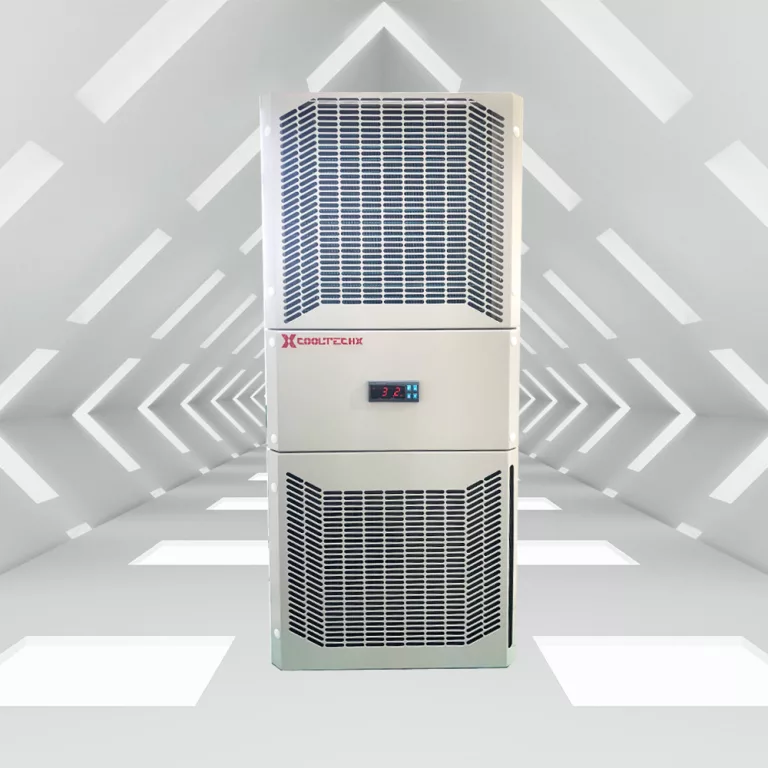

Cabinet air conditioner price follows the cooling capacity needed at your hottest operating condition, so compare offers at the same rating condition rather than by headline wattage. Indoor or outdoor construction, AC or DC supply, mounting, options such as heaters or condensate evaporation, customization and order quantity also change the price. Ask each supplier to itemize the unit, selected options and delivery scope; the comparison table below sets two quotes side by side.
What goes into an enclosure air conditioner quote?
The equipment price is one part of the purchasing decision. A useful quote separates the selected model from optional features and the work needed to integrate it into your cabinet.
| Quote item | What it covers | What helps us price it |
|---|---|---|
| Cooling unit | The selected capacity, electrical supply, housing and standard controls. | Application, heat load or existing model, ambient temperature. |
| Project options | Items such as condensate evaporation, heating, material changes or additional controls, where available. | The functions your cabinet needs. |
| Mounting configuration | Product dimensions, mounting drawings and any agreed equipment adaptations. | Cabinet opening, mounting position and space limits. |
| Order and delivery | Quantity, packaging, shipping arrangements and requested timing. | Sample or batch quantity, destination and delivery target. |
| Documentation and spare parts | Product documentation and any spare parts included in the equipment quotation. | Required drawings, manuals and spare-parts list. |
Cooltechx quotes the cooling equipment. The customer arranges installation.
What changes cabinet air conditioner price
1. Cooling capacity at your operating temperature
A small indoor control cabinet and a sun-exposed outdoor power cabinet place different demands on the cooling unit. Higher cooling duty can require different compressors, heat exchangers and enclosure dimensions. The useful comparison is the model that handles your application, including the hottest operating condition. Check the rating condition printed beside each capacity. A unit rated 500 W at L35/L35 (35 °C inside, 35 °C ambient) delivers less at L35/L50, so two quotes with the same headline watts can be different sizes for your site.
If the heat load is still being developed, send a component list or the existing unit’s nameplate. Our cabinet air conditioner sizing guide explains the inputs for a first selection.
2. Indoor or outdoor construction
Rain, dust, humidity and corrosive exposure affect the housing, sealing and materials. A standard indoor model can be a practical starting point for a clean factory. Outdoor projects need a configuration suited to their location, which changes the quotation.
3. AC or DC supply
Voltage, frequency and supply architecture influence the available models and electrical components. An OEM with a standard AC supply may choose from a different range than a telecom cabinet operating from a −48V DC system.
4. Mounting arrangement and available space
Side, door and top mounting create different installation requirements. For replacement orders, an existing opening or restricted door swing can make mechanical adaptation part of the project. A photo and a simple dimension sketch help identify the most practical route early.
5. Condensate handling, heating and controls
Compare what is included as standard. A quote with condensate evaporation, a heater or additional communication functions can cover more than a lower equipment-only offer. Splitting essential and optional features makes the commercial comparison easier.
6. Standard configuration or custom development
A standard model uses an established configuration. Changes to dimensions, supply voltage, materials or controls can add engineering and production work. For OEM programs, identifying the common configuration across multiple cabinet designs can simplify repeat purchasing.
7. Quantity and delivery plan
A sample order, a single replacement and a scheduled production batch have different preparation and logistics needs. Share both the immediate quantity and any expected follow-on demand so the quotation can reflect how you intend to buy.
Which Cooltechx range should your quote start from?
| Your application | A starting point | Useful quote details |
|---|---|---|
| Indoor control and automation cabinets | 500W CTACG0526N or indoor enclosure range | Internal heat load, AC supply and mounting space. |
| Outdoor electrical and power cabinets | 1500W CTACD1526W or outdoor enclosure range | Site temperature, sun exposure, protection and quantity. |
| Telecom cabinets with DC power | 1000–3000W CTDC series | DC supply details, cooling requirement and cabinet drawing. |
| An existing cabinet needing a new unit | Cooltechx enclosure cooling | Old nameplate, opening dimensions and target delivery. |
How to compare two quotations without missing project costs
Put both offers against the same application and separate equipment from the items around it. This makes it easier to see whether a price difference comes from capacity, options, delivery or spare-parts scope.
| Comparison line | Supplier A | Supplier B |
|---|---|---|
| Model and cooling duty | Model / capacity / rating condition | Model / capacity / rating condition |
| Power and mounting | Supply / dimensions / opening | Supply / dimensions / opening |
| Included options | List standard and optional items | List standard and optional items |
| Commercial basis | Currency / quantity / delivery term | Currency / quantity / delivery term |
| Delivery and support | Schedule / documentation / spares | Schedule / documentation / spares |
What to send for a first quotation
Send what you already have through the enquiry form: application, quantity, country and either a model number or cabinet photo. Add heat load, maximum ambient temperature and power supply if available. We review the application, recommend a product range and identify the configuration for your quotation.
For production orders, a repeatable cabinet drawing and a common option list help keep the sample and batch requirements aligned. For replacement work, the existing nameplate and mounting opening give us a practical starting point. If the unit being replaced is a compressed-air vortex cooler, the vortex cooler vs enclosure air conditioner running-cost example shows how to estimate the utility saving.
Frequently asked questions
Can I get a price before the heat load is finalized?
Yes. Send your application, cabinet photo and quantity. We will identify a starting model range and the remaining inputs for your budget quotation.
Does the quotation include shipping?
Shipping and delivery terms are stated in the proposal. Include the destination and whether you want equipment-only or delivered pricing.
Why is there no fixed price list here?
The same capacity can be supplied with different electrical, environmental and control configurations. A project quotation ties the price to the equipment and options you actually need.