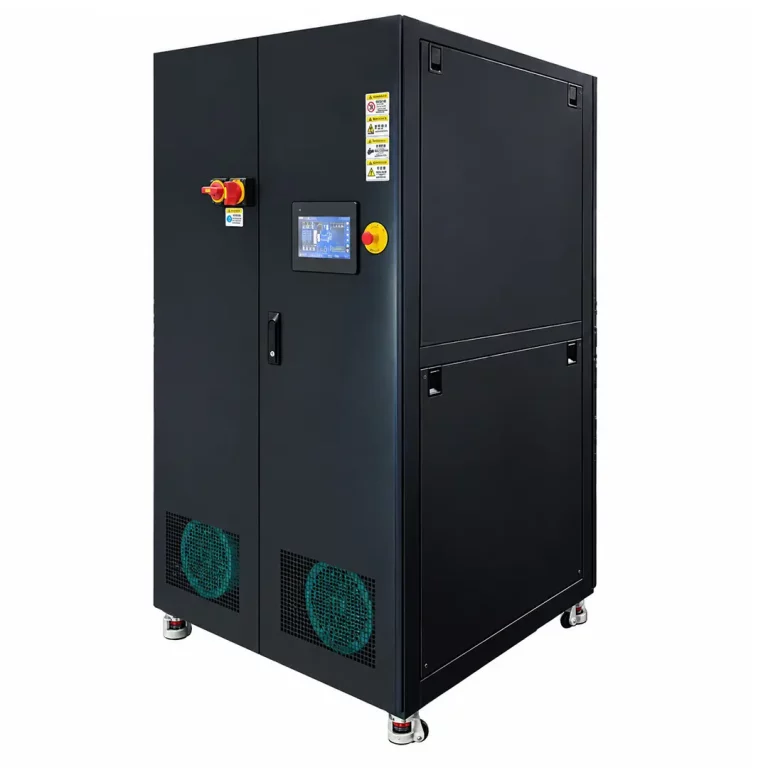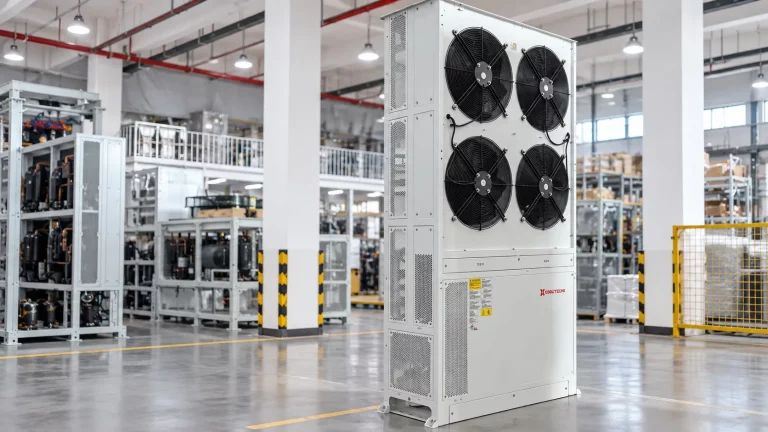

Quick answer: How to size a cabinet air conditioner: start with the heat actually released inside the enclosure, then check the hottest ambient condition, desired internal temperature, cabinet construction and installation constraints. Select a model whose rated performance covers that operating point—not simply a model whose nominal cooling capacity matches the cabinet size.
A cabinet that is too small for its heat load can run hot during peak conditions. A selection made only from a nominal wattage can also be misleading when the outdoor temperature, solar exposure, mounting position or power supply differs from the rating condition. This guide shows the information an engineering team needs to make a practical first selection.
What determines the right cabinet air conditioner size?
There is no reliable “one size per cabinet dimension” rule. Two enclosures of the same size may need very different cooling capacities. Start with these five inputs:
- Internal heat load: the heat loss from drives, power supplies, PLCs, transformers, resistors and other components inside the cabinet.
- Maximum ambient temperature: the temperature around the cabinet at the hottest expected time, including heat from nearby equipment.
- Target internal temperature: the maximum temperature your installed components are allowed to operate at, based on their own datasheets.
- Enclosure and location: indoor or outdoor use, cabinet dimensions, sealing/IP requirement, sun exposure, dust, humidity and corrosive conditions.
- Installation constraints: door, side or roof mounting; available clearance; airflow path; supply voltage; communication and certification requirements.
These inputs allow the supplier to check the model’s performance curve at the relevant conditions. The nominal cooling capacity shown in a catalogue is a comparison point; the delivered capacity changes with operating conditions.
Step 1: Calculate the internal heat load
List every component that releases heat inside the enclosure. Use each component manufacturer’s power-loss or heat-dissipation value where available. Do not use the component’s full nameplate power as its heat loss unless its datasheet says to do so.
- Variable-frequency drives, servo drives and soft starters
- AC/DC and DC/DC power supplies
- PLCs, I/O modules, switches and communication equipment
- Transformers, contactors, relays and terminal equipment
- Braking resistors, heaters, batteries or other intermittent loads
For an item with known input power and efficiency, the heat loss can be estimated as:
Heat loss (W) = Input power (W) × (1 − efficiency)
For intermittent devices, record both the heat loss and the duty cycle. Whether an intermittent peak must be treated as a continuous load depends on its duration, the enclosure thermal mass and the allowable internal temperature. If that is unclear, send the operating profile with the enquiry rather than relying on a generic multiplier.
Example: building a heat-load list
A control cabinet may contain a drive, power supply, PLC/I/O and several contactors. Add the documented heat loss of each item to obtain the base internal heat load. Then identify any loads that can operate together at peak. The result is a starting point for selection—not yet the final model choice.
Step 2: Define the real operating conditions
Ask for the maximum ambient temperature at the installation location, rather than the site’s annual average. For an outdoor enclosure, note the cabinet colour, orientation, direct sun exposure and whether a shade canopy is used. For an indoor cabinet, identify nearby furnaces, process equipment or restricted plant-room airflow.
Also confirm the required internal temperature. It should be based on the allowable temperature of the most sensitive installed component, not an arbitrary thermostat setting. A useful enquiry records both temperatures clearly:
- Maximum ambient around cabinet: ___ °C
- Required / maximum internal temperature: ___ °C
The difference between them, together with the internal heat load, is what the product engineer uses to compare candidate models at their stated test conditions.
Step 3: Check the enclosure and installation
Cooling capacity alone does not make a selection complete. Confirm that the cabinet air conditioner can be mounted, serviced and sealed correctly in the actual enclosure.
| Check | Why it matters |
|---|---|
| Mounting position | Door, side and roof mounting affect available space, condensate routing and service access. |
| Internal airflow path | Supply air must reach the heat-generating components instead of short-circuiting directly back to the return air path. |
| External clearance | Restricted condenser airflow can reduce cooling performance and make cleaning difficult. |
| Ingress protection and environment | Dust, rain, washdown, salt mist and corrosive gases affect the required cabinet and unit protection level. |
| Electrical supply and controls | Voltage, frequency, DC supply, alarm contacts and remote communication must match the site system. |
For outdoor cabinets, also provide a photo of the installation location if possible. It helps reveal practical issues such as direct sun, limited door clearance or an obstructed condenser side.
Step 4: Compare cooling capacity in watts and BTU/h
Manufacturers may state cooling capacity in watts (W) or British thermal units per hour (BTU/h). Use the same unit before comparing options:
- 1 W ≈ 3.412 BTU/h
- 1,000 W ≈ 3,412 BTU/h
More importantly, compare capacity at the same test condition. A model’s nominal capacity is not a promise that it will deliver that exact capacity at every ambient temperature or internal set point. Ask for the relevant performance data when the application is hot, outdoor or business-critical.
Step 5: Choose a model and leave a justified margin
Once the heat load and conditions are defined, shortlist models that satisfy the operating point. A margin may be appropriate for uncertainty, seasonal heat, planned expansion or a high-consequence application. The right margin is project-specific: a fixed percentage should not replace checking the unit’s actual performance data.
If the calculated requirement falls between standard models, compare the next available model with the installation constraints and expected load growth. Do not choose a smaller unit solely because the enclosure is compact; confirm its delivered capacity and airflow arrangement first.
Common cabinet air conditioner sizing mistakes
- Using component nameplate power as heat loss. Use documented power dissipation or efficiency data instead.
- Using average ambient temperature. Size against the hottest realistic operating condition.
- Ignoring solar gain on outdoor cabinets. Document direct sun, orientation and shade provisions.
- Ignoring airflow and service clearance. A correctly rated model can still underperform if the condenser side is blocked or internal air short-circuits.
- Forgetting the power supply and protection level. Confirm AC/DC supply, frequency, voltage, mounting cut-out and environmental requirement before purchase.
Information to prepare for a cabinet cooling quotation
To receive a useful first recommendation, send the following information. A cabinet drawing, component list and site photo will make the selection faster and more reliable.
- Total internal heat loss (W), with a component heat-loss list where possible
- Maximum ambient temperature and required internal temperature
- Cabinet dimensions and a drawing or photo
- Indoor/outdoor location, sun exposure and environmental conditions
- Preferred mounting position and available installation clearance
- Available power supply: AC/DC voltage and frequency
- Required IP rating, certifications, alarms and communication interface
Explore cabinet air conditioner options
Browse our cabinet air conditioners to compare available enclosure cooling options. For compact AC-powered enclosures, see the 300W AC Cabinet Air Conditioner (CTACG0326N). For higher-load outdoor installations, review the 1500W Outdoor Cabinet Air Conditioner (CTC015AS).
Need a selection check? Contact COOLTECHX with the seven items above. Our team can review the operating conditions and recommend a suitable cabinet cooling configuration.
Frequently asked questions
Can I size a cabinet air conditioner from enclosure dimensions alone?
No. Cabinet dimensions help with mounting and installation, but the primary selection inputs are internal heat loss, maximum ambient temperature, required internal temperature and the actual installation conditions.
Should I select the next larger standard capacity?
If the calculated operating-point requirement falls between models, a larger candidate is often worth evaluating. Confirm its performance, physical fit, power supply and control requirements rather than applying a universal rule.
When does a DC cabinet air conditioner make sense?
A DC model may suit an enclosure where the available site supply and system design call for DC power. Confirm the nominal voltage, allowable voltage range, installation environment and monitoring requirements before selection.
What is the fastest way to obtain a model recommendation?
Send the heat-load list, maximum ambient temperature, target internal temperature, cabinet drawing, site photo, power supply and environmental requirements. This lets the supplier check capacity and installation suitability together.