
Introduction: The Thermal Management Challenge
Battery energy storage systems (BESS) generate significant heat during charge and discharge cycles. A 5MWh lithium-ion battery system can produce 500–800 kW of thermal energy during peak operation, depending on chemistry, state of charge, and ambient conditions. Without effective thermal management, battery cells degrade rapidly, cycle life shortens, and safety risks increase.
For utility-scale projects between 1MWh and 5MWh, project developers and EPC contractors face a critical decision: BESS air cooling or liquid cooling? This choice impacts capital expenditure (CAPEX), operating efficiency, maintenance burden, and total cost of ownership (TCO) over a 10–15 year asset life.
Both technologies can meet IEC 62619 thermal management standards. But they differ fundamentally in efficiency, scalability, and suitability for different climates and battery chemistries. This article provides an objective, technical comparison to guide your decision.
How Air Cooling Works in BESS
Principle and Components
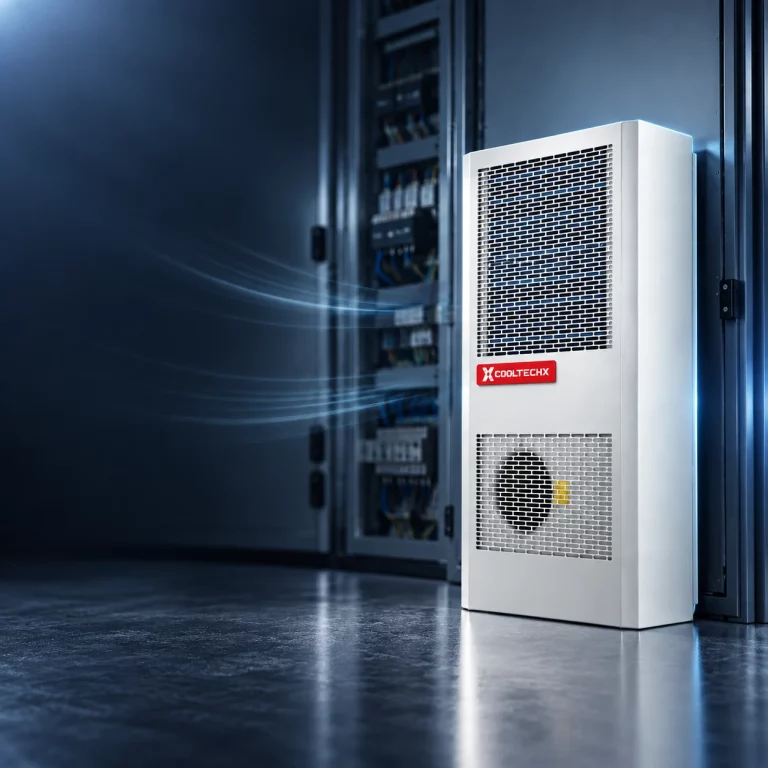
Air cooling uses forced convection to remove heat from battery containers. Cool ambient air (or pre-cooled air from a chiller) passes through heat exchangers mounted on or integrated into the energy storage container. The air absorbs thermal energy from the battery cells and exhaust air is vented to the atmosphere.
Key components include axial or centrifugal fans (1–5 kW per unit), aluminum or copper fin heat exchangers, ducting and air distribution manifolds, temperature sensors and control logic, and optional pre-cooling chiller for hot climates.
Efficiency: COP and Real-World Performance
The coefficient of performance (COP) for air cooling systems typically ranges from 2.5 to 3.5 in moderate climates (15–30°C ambient). In hot climates (> 35°C ambient), COP drops to 1.8–2.2 because the temperature differential between the heat exchanger and ambient air narrows, requiring larger fans and more frequent operation.
Advantages and Limitations
Air cooling offers lower CAPEX (30–40% less than liquid cooling for equivalent capacity), simpler installation, familiar technology with a proven track record since the 1990s, and easier modularity for scaling. Its limitations include climate dependency (performance degrades significantly above 32°C ambient), space requirements (heat exchangers occupy 10–15% of container volume), fan noise (75–85 dB at full load), and lower efficiency at scale beyond 3MWh.
How Liquid Cooling Works in BESS
Principle and Components
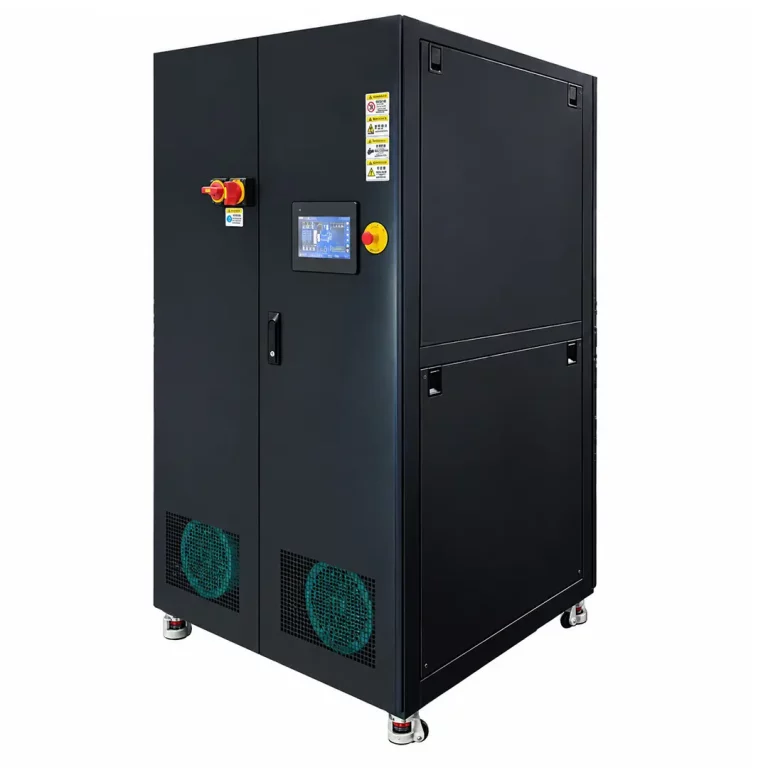
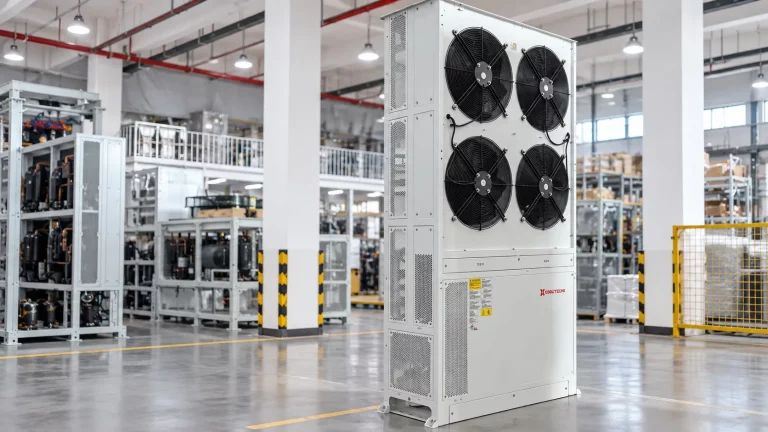
Liquid cooling circulates a heat transfer fluid (typically a glycol-water mixture or synthetic dielectric fluid) through cold plates attached to battery modules. The fluid absorbs heat directly from cells, flows to a remote chiller unit, and returns cooled to the battery pack.
Key components include a sealed liquid circulation pump (0.5–2 kW), cold plates or immersion cooling manifolds, a liquid-to-air chiller (remote or integrated), expansion tank and pressure relief, and fluid filtration and conditioning system.
Efficiency: COP and Real-World Performance
Liquid cooling achieves COP 3.5–5.0 across a wide range of ambient temperatures (–10°C to +45°C). The superior efficiency stems from direct contact between fluid and heat-generating cells, higher thermal conductivity of liquid vs. air (0.6 W/m·K for water vs. 0.026 W/m·K for air), and smaller temperature gradients within the battery pack (±2°C vs. ±5°C for air cooling). Even in extreme heat (40°C+ ambient), liquid cooling maintains COP > 3.0.
Advantages and Limitations
Liquid cooling delivers superior efficiency (COP 3.5–5.0), compact design with higher energy density (MWh per m³), uniform cell temperature (±1–2°C), strong hot-climate performance, quiet operation (pump noise < 65 dB), and 15–25% longer battery cycle life through precise temperature control. Limitations include higher CAPEX (40–60% more upfront), greater maintenance complexity (annual fluid checks, coolant replacement every 5–7 years), leak risk requiring secondary containment, and more intensive installation integration.
Air Cooling vs Liquid Cooling: Head-to-Head Comparison
|
Criterion
|
Air Cooling
|
Liquid Cooling
|
|
COP (Moderate Climate)
|
2.5–3.5
|
3.5–5.0
|
|
COP (Hot Climate, >35°C)
|
1.8–2.2
|
3.0–4.2
|
|
Initial CAPEX (per MWh)
|
$80–120K
|
$140–200K
|
|
Annual Operating Cost (per MWh)
|
$12–18K
|
$8–12K
|
|
10-Year TCO (per MWh)
|
$200–280K
|
$180–240K
|
|
System Efficiency (%)
|
88–92%
|
93–97%
|
|
Temperature Uniformity
|
±3–5°C
|
±1–2°C
|
|
Maintenance Interval
|
6–12 months
|
12 months (annual)
|
|
Noise Level (dB)
|
75–85
|
60–70
|
|
Best for LFP Chemistry
|
✓ Excellent
|
✓ Good
|
|
Best for NMC Chemistry
|
✗ Marginal
|
✓ Excellent
|
|
Suitable Ambient Range
|
0–32°C
|
–10–45°C
|
|
Space Efficiency (MWh/m³)
|
0.8–1.2
|
1.4–1.8
|
|
Scalability (1–5MWh)
|
Good (1–2MWh)
|
Excellent (2–5MWh)
|
Real-World Scenarios: Three Case Studies
Scenario 1: Utility-Scale Grid Storage (5MWh, Hot Climate)
Project profile: Southwest US (Phoenix, Arizona; 45°C peak ambient), NMC 622 chemistry, 4-hour system for peak shaving and grid stabilization.
Air cooling analysis: COP 1.8–2.0 in summer, 18+ hours/day chiller runtime, $95K annual cooling cost, $1.4M 10-year TCO. Liquid cooling analysis: COP 3.5–4.0 in summer, 8–10 hours/day chiller runtime, $48K annual cooling cost, $1.2M 10-year TCO. Savings: $200K over project life.
Recommendation: Liquid cooling. The 5MWh scale, NMC chemistry, and extreme heat make liquid cooling’s superior efficiency and reliability essential. The $60K higher CAPEX is recovered in 3 years.
Scenario 2: Commercial & Industrial Retrofit (1MWh, Temperate Climate)
Project profile: Northern California (28°C peak ambient), LFP chemistry, 2-hour system for demand charge reduction and backup power.
Air cooling analysis: COP 3.0–3.2, $8K annual cooling cost, $140K 10-year TCO, simple installation. Liquid cooling analysis: COP 4.2–4.5, $5K annual cooling cost, $155K 10-year TCO, more complex integration.
Recommendation: Air cooling. For 1MWh LFP in a temperate climate, air cooling’s lower CAPEX ($80K vs. $140K) and simpler installation outweigh liquid cooling’s modest efficiency gains. Payback period for liquid cooling exceeds 10 years.
Scenario 3: Island Microgrid (2MWh, Variable Climate)
Project profile: Caribbean island (30°C average, 35°C peak; high humidity), LFP with NMC hybrid pack, 3-hour system for renewable integration and grid stability.
Air cooling analysis: COP 2.8–3.0 (humidity reduces effectiveness), corrosion risk in salt-air environment, $22K annual cooling cost, $220K 10-year TCO. Liquid cooling analysis: COP 4.0–4.5 (robust in humidity), sealed system reduces corrosion risk, $14K annual cooling cost, $210K 10-year TCO.
Recommendation: Liquid cooling. The 2MWh scale, mixed chemistry, hot/humid climate, and corrosion risk favor liquid cooling. The sealed system and superior efficiency justify the higher CAPEX, especially for remote island applications with limited maintenance access.
Which Should You Choose? Decision Checklist
Use this framework to evaluate your project:
Project Size:
-
1–1.5MWh → Air cooling preferred
-
1.5–2.5MWh → Either (depends on other factors)
-
2.5–5MWh → Liquid cooling preferred
Battery Chemistry:
-
LFP (LiFePO₄) → Air cooling acceptable
-
NMC, NCA, or blended → Liquid cooling recommended
-
High-density chemistry (>250 Wh/kg) → Liquid cooling required
Ambient Climate:
-
Cool/temperate (< 25°C average) → Air cooling viable
-
Warm (25–32°C) → Either (evaluate TCO)
-
Hot (> 32°C) or extreme variation → Liquid cooling essential
-
High humidity or salt-air environment → Liquid cooling (corrosion protection)
Budget Constraints:
-
Minimize upfront CAPEX → Air cooling
-
Optimize 10-year TCO → Liquid cooling (for 2MWh+)
-
Limited O&M budget → Air cooling (lower maintenance cost)
Site Constraints:
-
Limited space (high MWh/m³ required) → Liquid cooling
-
Noise-sensitive area → Liquid cooling
-
Remote/difficult access → Liquid cooling (less frequent service)
Scoring: Count checkmarks in each column. Liquid cooling wins if 4+ criteria favor it.
FAQ: Common Questions About BESS Thermal Management
What is the actual cost difference between air and liquid cooling over 10 years?
For a 3MWh system in a 32°C climate, air cooling totals approximately $430K (CAPEX + operating) versus $510K for liquid cooling. However, liquid cooling extends battery cycle life by 20%, delaying replacement by 2–3 years (value: $150–200K). Including battery longevity and downtime risk, the true 10-year TCO favors liquid cooling by $80–120K for systems at or above 2MWh.
Can I retrofit an air-cooled system to liquid cooling later?
Retrofitting is difficult and expensive—typically 60–75% of a new liquid cooling system’s cost, with significant operational disruption (2–4 weeks downtime for rewiring cold plates, installing a new chiller, and reconfiguring container ducting). It is far better to choose the right technology at project inception.
What maintenance does each system require?
Air cooling requires visual inspection every month, filter cleaning or replacement every 6 months, annual fan bearing lubrication, and fan motor replacement every 3–5 years. Liquid cooling requires monthly coolant level checks, annual fluid analysis, coolant flush and refill every 2–7 years (per manufacturer spec), and pump servicing every 5–10 years. Annual maintenance costs: air cooling $2–4K/year per MWh; liquid cooling $3–5K/year per MWh.
Which cooling system is better for battery safety?
Liquid cooling’s temperature uniformity (±1–2°C vs. ±3–5°C for air) provides a measurable safety advantage, especially for high-density NMC packs. Air cooling risks uneven hot spots if cells are not evenly cooled. Both are safe when properly designed, but liquid cooling’s superior temperature control reduces thermal runaway risk in high-energy-density chemistries.
Conclusion and Next Steps
The choice between BESS air cooling and liquid cooling depends on your specific project parameters. For 1–2MWh LFP systems in temperate climates with budget constraints, air cooling delivers excellent value. For 2–5MWh projects with NMC chemistry, hot climates, or long-term TCO optimization, liquid cooling provides superior efficiency, reliability, and battery longevity.
Key points to remember: air cooling COP is 2.5–3.5 in moderate climates; liquid cooling COP is 3.5–5.0 across all climates. Air cooling CAPEX is 30–40% lower, but liquid cooling reduces 10-year TCO by $80–120K for 2MWh+ systems. Liquid cooling extends battery cycle life by 15–25%, recovering the CAPEX premium through deferred replacement. Climate and chemistry matter most. And retrofitting is expensive—choose the right technology at project inception.
COOLTECHX manufactures both CE and UL certified thermal management systems for utility-scale BESS projects:
-
Energy Storage Container Air Conditioner – Proven, cost-effective cooling for 1–2MWh LFP systems
-
5MWh Liquid Cooling System – Advanced thermal management for large-scale, high-density energy storage
Contact our thermal engineering team to discuss your project requirements, climate conditions, and battery chemistry. We’ll help you select the optimal cooling solution for maximum efficiency, reliability, and return on investment.
References
-
National Renewable Energy Laboratory (NREL). “Thermal Management of Battery Energy Storage Systems: Performance and Cost Analysis.” NREL/TP-5700-78236, 2021. https://www.nrel.gov/
-
International Electrotechnical Commission. “IEC 62619: Secondary cells and batteries containing alkaline or other non-acid electrolyte – Safety requirements for portable sealed secondary lithium cells and batteries for use in electronic equipment.” IEC, 2017. https://www.iec.ch/
-
International Energy Agency (IEA). “Battery Storage Technology Roadmap.” IEA Publications, 2023. https://www.iea.org/