
A sealed air-to-air heat exchanger can cool a control cabinet only when the hottest air reaching its external intake is cooler than the allowed internal temperature. It also needs enough sensible capacity at that temperature difference to cover the heat load. An enclosure air conditioner uses an active refrigeration circuit, so it can hold the cabinet below shop air temperature. That works only if its stated capacity at your actual internal and ambient temperatures covers the load.
How the two devices differ
Both devices keep shop air and cabinet air in separate circuits, so the internal air does not mix with the room. An air-to-air heat exchanger moves heat passively through a core, with fans driving air on each side. Its output rises and falls with the temperature difference between the two air streams. For that reason, exchanger performance is stated in W/K: watts transferred per kelvin of temperature difference.
An enclosure air conditioner uses a compressor and refrigerant to pump heat out against the temperature gradient. Datasheets give its capacity in W at named internal and ambient temperatures, so that figure has to be converted to your project’s internal and ambient temperatures.
A worked check on one cabinet
Consider an indoor control cabinet serving a production line. Use the following illustrative inputs.
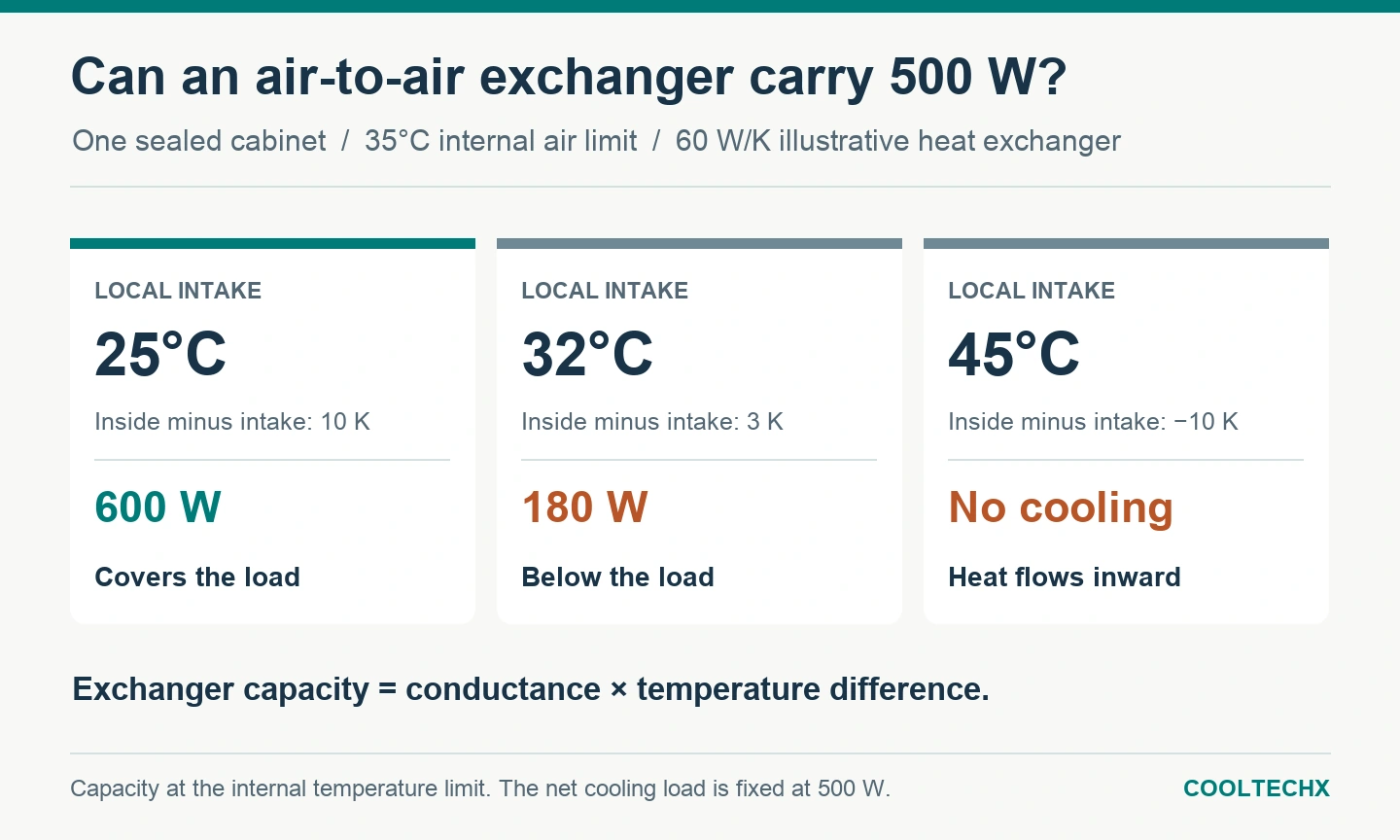
- One indoor cabinet with a net load of 500 W that the cooling device must remove. For this comparison, assume the same net duty at all three temperatures. In a project, include heat entering or leaving through the walls, direct sun and nearby process heat when establishing the net duty.
- Allowable internal air temperature of 35 °C.
- Shop air at the external intake of 25 °C, then 32 °C, then 45 °C.
- A hypothetical heat exchanger rated 60 W/K across this range and installed as its maker specifies.
The first-pass formula is Q = K × (Tinternal − Tambient), with K in W/K, the difference in K and Q in W.
| Intake | ΔT | Cooling available at 35 °C | vs 500 W |
|---|---|---|---|
| 25 °C | 10 K | 600 W | Covers load |
| 32 °C | 3 K | 180 W | Short |
| 45 °C | −10 K | None | Gradient reversed |
At 25 °C, 600 W is what the exchanger could move at a 10 K difference. It does not reject 600 W, because the cabinet only produces 500 W. In this simple model the cabinet settles where 60 W/K × ΔT = 500 W. That gives ΔT ≈ 8.3 K and an internal temperature of about 33.3 °C. The 100 W gap is not a recommended margin. Choose your margin from the real uncertainty in load, intake temperature and fouling.
At 32 °C the same exchanger moves only 180 W. Carrying 500 W across 3 K would need about 167 W/K (500 ÷ 3). At 45 °C the intake air is 10 K hotter than the limit, so heat would flow into the cabinet. A sealed air-to-air exchanger using that 45 °C intake cannot hold the cabinet at 35 °C. Of the two options here, the refrigerated unit can meet the target if its sensible capacity at 35 °C internal and 45 °C ambient covers the net duty.
Checks on a real project
- Measure the hottest local intake temperature at the device’s external inlet, during the hottest shift and season. Air near ovens, presses or under the roof can be well above the hall average.
- Build the full heat load, including wall transfer and nearby process heat. Our guide on how to size a cabinet air conditioner covers that process step by step.
- Include any heat the device’s internal fan adds to the cabinet if its rating leaves that heat out. Read each datasheet at your operating point. For an exchanger, use the W/K curve. For an air conditioner, use the capacity at your internal and ambient temperatures.
- Compare the air conditioner’s sensible cooling capacity with the load. Part of total capacity can go into removing moisture.
- Plan condensate handling, either a drain route or evaporation. Keep doors closed and gaskets intact to limit humid air entry.
- Check exterior fouling. Both devices pass shop air over an external heat transfer surface, and dust or oil mist can coat it even when the cabinet stays sealed. Ask about filters, cleaning access and service intervals.
- Confirm the cutout size and position, the wall strength and the clearances. An existing cutout may not match a new device.
From datasheet comparison to RFQ
Give each supplier the same operating point in your request for quotation. State the heat load and how you derived it, the allowable internal temperature and the hottest measured intake temperature. Also give the cabinet dimensions, the mounting position and cutout limits, the shop air contaminants and the condensate options.
If the check shows you need active cooling, see our indoor cabinet air conditioner range.