
In an illustrative 500 W-class example with 2,000 cooling hours a year, a vortex cooler uses about US$1,699 of compressed air and a compressor-based cabinet air conditioner uses about US$67 of electricity. The figures assume US$0.02 per standard m³ of compressed air and US$0.12 per kWh. Vortex costs scale directly with your air price and cooling hours, so the calculation below shows how to substitute your own figures.
Vortex cooler vs enclosure air conditioner at a glance
| Decision | Vortex enclosure cooler | Compressor-based cabinet AC |
|---|---|---|
| Energy supply | Filtered compressed air at the required pressure and flow. | Electrical supply matching the selected unit. |
| Cooling arrangement | Cold air enters the enclosure and air is exhausted. | Cabinet air recirculates through a separate internal air circuit. |
| Installation | Compact cooler; needs air supply, filtration and a distribution arrangement. | Larger mounting opening; needs electrical connection and external airflow clearance. |
| Running-cost driver | Air consumption, air-generation cost and active cooling hours. | Measured electrical demand and active cooling hours. |
| Service considerations | Air quality, filters, supply pressure and control operation. | Heat-exchanger cleaning, condensate management and equipment maintenance. |
| A useful starting point | Limited mounting space, suitable plant air or intermittent cooling. | Regular industrial cooling, multiple cabinets or a project to reduce compressed-air demand. |
Why compressed-air cost belongs in the comparison
A vortex cooler can have very little electrical load at the cabinet while still using energy at the compressor station. Its operating cost follows the quantity of air consumed and the cost of supplying that air.
Thermostatic control reduces consumption by stopping the air when cooling is not needed. For a fair budget, use active cooling hours rather than assuming either device runs continuously for the entire factory shift.
Illustrative running-cost comparison for a 500W-class application
This 500W-class example combines equipment consumption figures with the utility rates and active cooling hours shown below. The two reference units publish similar cooling capacity under different rating conditions, so this compares utility cost, not matched cooling performance.
| Input | Vortex example | Cabinet AC example |
|---|---|---|
| Reference equipment | Vortex cabinet cooler with electronic thermostat control | Cooltechx CTACG0526N |
| Published cooling capacity | 1,700 Btu/h, approximately 498 W | 500 W at L35/L35 |
| Consumption basis | 25 SCFM at 100 psig | 280 W electrical input, listed separately from the L35/L35 rating |
| Assumed utility cost | US$0.02 per standard m³ of compressed air | US$0.12 per kWh |
| Assumed active cooling time | 2,000 hours/year | 2,000 hours/year |
Vortex air volume: 25 × 0.0283168 × 60 = 42.48 standard m³/hour.
Vortex air cost: 42.48 × $0.02 = approximately $0.85/hour.
Cabinet AC electricity: 0.280 × $0.12 = $0.0336/hour.
At 2,000 active cooling hours, the calculated utility costs are approximately $1,699/year for compressed air and $67/year for the cabinet AC. The difference is approximately $1,632 per cabinet per year under these assumptions.
Vortex cost scales linearly with the air rate: at US$0.01 per standard m³, the vortex figures halve. The DOE fact sheet listed under the calculation references shows how to derive your plant’s rate from compressor input power, operating hours and electricity price. The estimate excludes installation, maintenance and standby or control power. Realized savings also depend on how your compressors respond when demand falls.
How much does the result change with operating hours?
| Active cooling hours/year | Vortex air cost | Cabinet AC electricity | Calculated utility-cost difference |
|---|---|---|---|
| 500 | $425 | $17 | $408 |
| 2,000 | $1,699 | $67 | $1,632 |
| 4,000 | $3,398 | $134 | $3,264 |
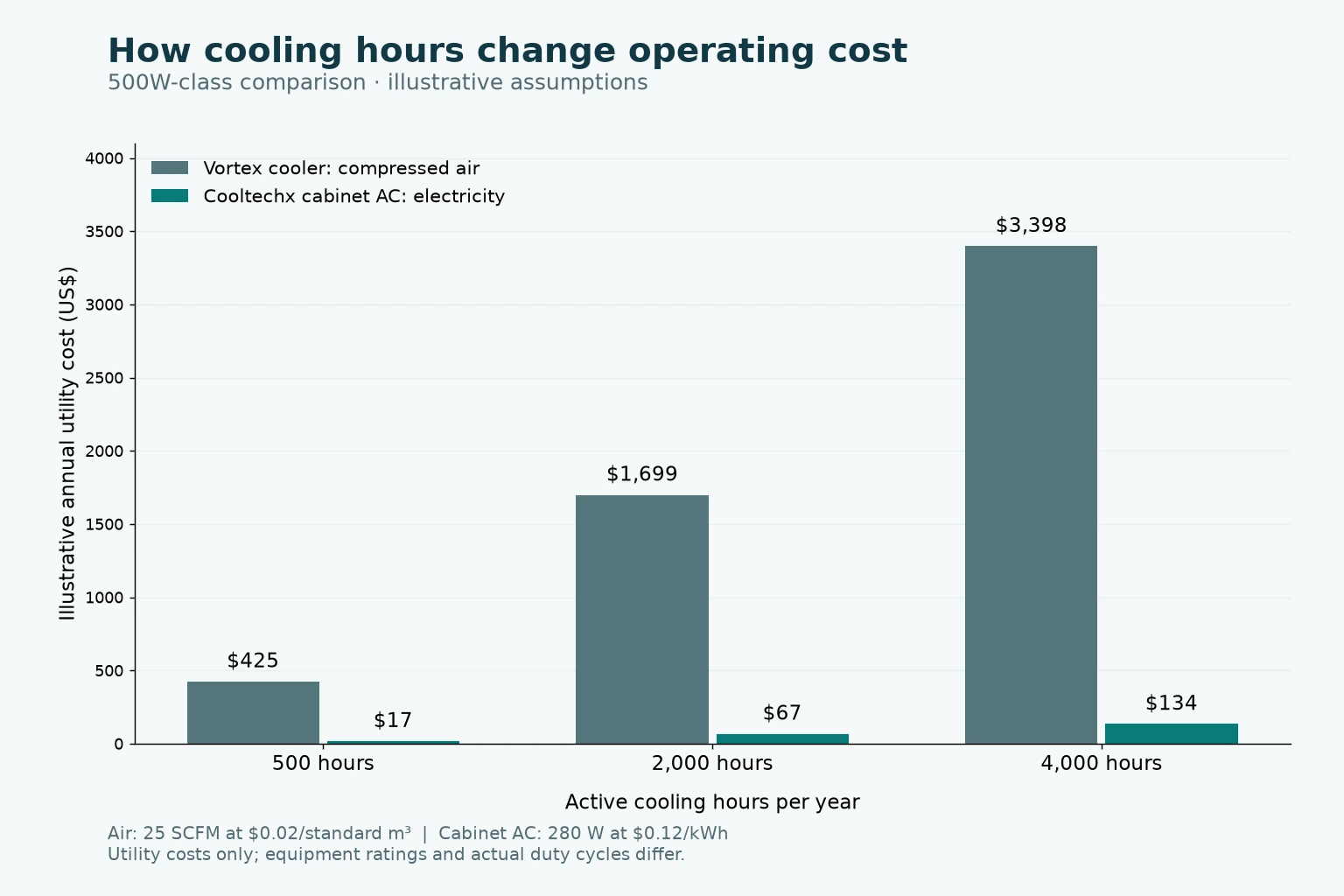
A cooler that runs only in occasional hot spells gives a small case for change. Long duty hours and many similar cabinets make the case larger, so measure run time before deciding on a rollout.
Estimate the payback for your own installation
Simple payback = additional installed investment ÷ annual net savings. For a retrofit, use the full installed cost of the cabinet air conditioner: the equipment price plus your own mounting and electrical work, less any avoided vortex-cooler replacement cost. For a new cabinet, use the difference between the two installed prices. Then estimate utility and maintenance changes on the same annual basis. The cabinet air conditioner price guide explains what a quotation covers.
Using only the illustrative utility difference of $1,632/year, an assumed additional installed investment of $1,000 gives approximately 0.61 years, or 7.4 months. The $1,000 is an example input, not a Cooltechx price.
When a vortex cooler remains a practical choice
A small mounting footprint, short operating periods or spare capacity in an existing compressed-air system can favor vortex cooling. The vortex tube itself has no moving parts. A thermostatically controlled system adds a thermostat and a solenoid valve, and it needs clean, dry plant air at the rated pressure. In those cases, weigh the air cost above against the mounting space saved.
When a cabinet air conditioner is the better fit
Compressor cooling suits cabinets that need cooling for most operating hours, plants short of compressed-air capacity and programs replacing coolers on many similar cabinets. It uses no plant air. A retrofit does need a mounting opening, external airflow clearance and a suitable power supply.
The 500W CTACG0526N provides a compact indoor starting point. For other loads and environments, explore the cabinet air conditioner range.
What to send for a replacement quote
To start, send a nameplate photo and a cabinet photo through the enquiry form. Add the current air consumption, supply pressure, working schedule and electricity or compressed-air cost if available. For multiple cabinets, note whether the loads and mounting arrangements are similar. This helps identify a practical trial location before a wider rollout.
Frequently asked questions
Is compressed-air cooling free if the compressor is already running?
It still consumes air that the plant must supply. The financial effect of removing that demand depends on compressor controls, loading and the way air costs are allocated.
Does a vortex cooler run all the time?
A thermostatically controlled system supplies cooling when required. Its duty cycle belongs in the cost calculation.
Can I replace a vortex cooler with a cabinet air conditioner?
Often, if the cabinet has room for the mounting opening and external airflow clearance, and a suitable power supply is available.
Which option is cheaper to buy?
The comparison depends on cooler size, controls, available utilities and installation work. Request the full installed scope for each option; the example above compares utility costs only.
Calculation references
- Vortex cooling capacity: manufacturer catalogue for the reference vortex cabinet cooler family. Air consumption of 25 SCFM at 100 psig for the thermostat-controlled model: manufacturer application note on cabinet cooler air supply.
- Cabinet AC: Cooltechx CTACG0526N product data, 500 W at L35/L35, with 280 W electrical input listed separately.
- U.S. Department of Energy: compressed-air cost calculation.
- U.S. Department of Energy compressed-air evaluation and part-load behavior.