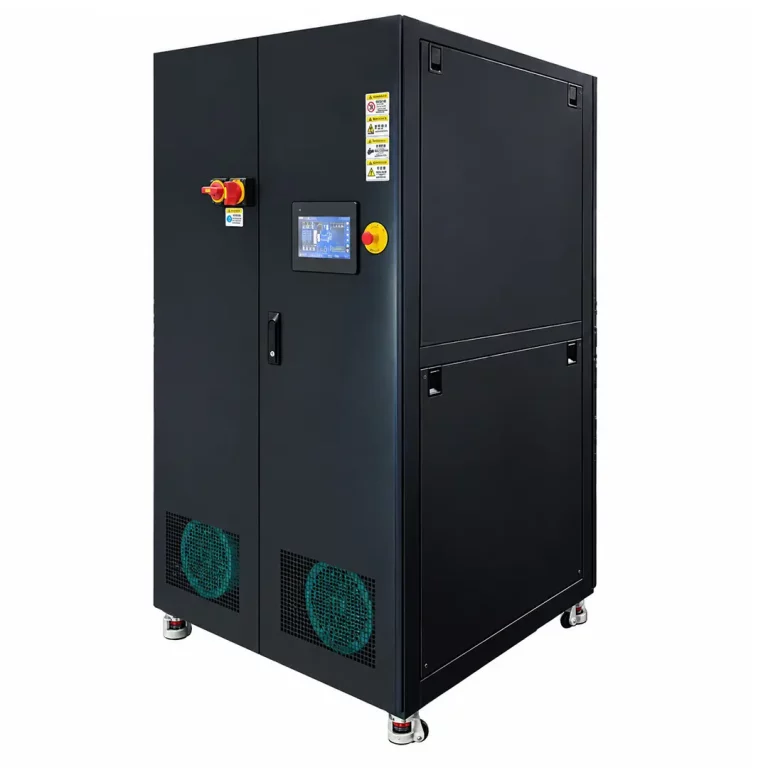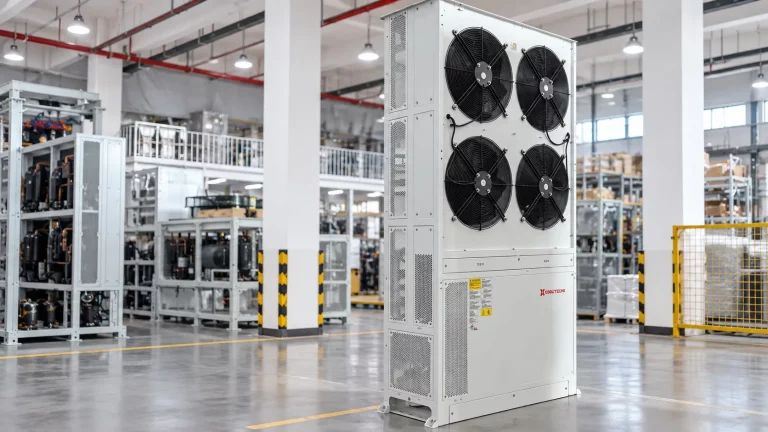

Quick answer: Compressor-based and thermoelectric (TEC) cooling solve different enclosure-cooling problems. The right choice depends on the required heat removal at the design ambient condition, cabinet space, available power, environmental exposure, controls and service plan—not on a technology label alone.
This guide compares the two approaches at a selection level. Final capability, operating range, protection and interfaces must be confirmed from the documentation of the selected equipment.
What is the difference between compressor and TEC cabinet cooling?
A compressor-based cabinet air conditioner uses a refrigeration circuit to move heat from inside the enclosure to the outside environment. A thermoelectric cooler uses the Peltier effect: when direct current passes through a thermoelectric module, heat is moved from one side of the module to the other. In both cases, the enclosure layout and the heat path outside the cabinet matter to real operating performance.
| Selection factor | Compressor-based cooling | Thermoelectric (TEC) cooling |
|---|---|---|
| Typical fit | Applications that require a refrigeration-based cabinet AC solution | Compact thermal-management applications where a TEC configuration is appropriate |
| Key design inputs | Heat load, design ambient, power supply, installation and service access | Heat load, design ambient, DC supply, heat rejection space and installation |
| Site considerations | Cabinet mounting, airflow paths, external heat rejection and maintenance access | Module heat rejection, cabinet layout, external airflow and power availability |
| What must be verified | Capacity at the project operating point, controls, environmental requirements and documents | Capacity at the project operating point, thermal design, controls and environmental requirements |
When compressor-based cabinet cooling may be appropriate
Compressor-based cooling is commonly considered when an enclosure requires a refrigeration-based air-conditioning solution. The application still has to be defined through its heat load and operating conditions. An enclosure in direct sun, a cabinet with limited external clearance or a site with unusual exposure can change the practical equipment choice.
Before selecting a unit, collect the installed equipment heat dissipation, cabinet drawing, installation position, site ambient range and available input power. The cabinet air conditioner sizing guide explains the information required to establish an equipment selection point.
When thermoelectric cooling may be appropriate
TEC cooling can be considered where the enclosure thermal requirement, available DC power, packaging constraints and required operating condition suit a thermoelectric design. It should not be selected only because the enclosure is physically small: the required heat removal and the temperature difference between the cabinet and the surrounding environment still need to be evaluated.
Any fan arrangement, controller, enclosure protection and outdoor suitability are configuration-specific. Confirm them from the selected unit documentation rather than assuming that they are common to every TEC cooler.
How to compare the two approaches for a real project
- Calculate the enclosure heat load. Use equipment dissipation and realistic operating conditions, not a generic cabinet size.
- Define the site. State the design ambient range, sun exposure, dust, moisture, corrosion risk and installation location.
- Check physical integration. Share cabinet drawings, mounting surface, clearance and internal layout.
- Confirm input power and controls. Identify the available supply and any alarm, monitoring or communications requirements.
- Compare documented operating points. Ask suppliers to evaluate the selected configuration at the same project conditions.
Do not compare nominal capacity alone
A catalogue value without its test or rating condition does not show how the equipment will perform at the actual site. Compare like for like: the required indoor condition, design ambient condition, cabinet heat load, installation arrangement and control scope should be the same for every option under review.
Where a DC-powered cabinet AC is under consideration, see DC or AC Cabinet Air Conditioner: Pros, Cons and Best Use Cases for the power-supply selection questions.
Explore cabinet air conditioner options
Browse the current cabinet air conditioner range for available configurations. A final proposal should be based on the documented model performance and the complete project input set.
Need a project review? Contact Cooltechx with the cabinet drawing, heat load and site conditions.
FAQ
Which technology is better for an electrical cabinet?
Neither is universally better. Select against the project heat load, operating condition, cabinet layout, available power and documented performance of the proposed configuration.
Can a nominal cooling capacity be used to compare two units?
Only when both values are stated at comparable operating conditions. Verify the rating condition and the full project requirements before making a selection.