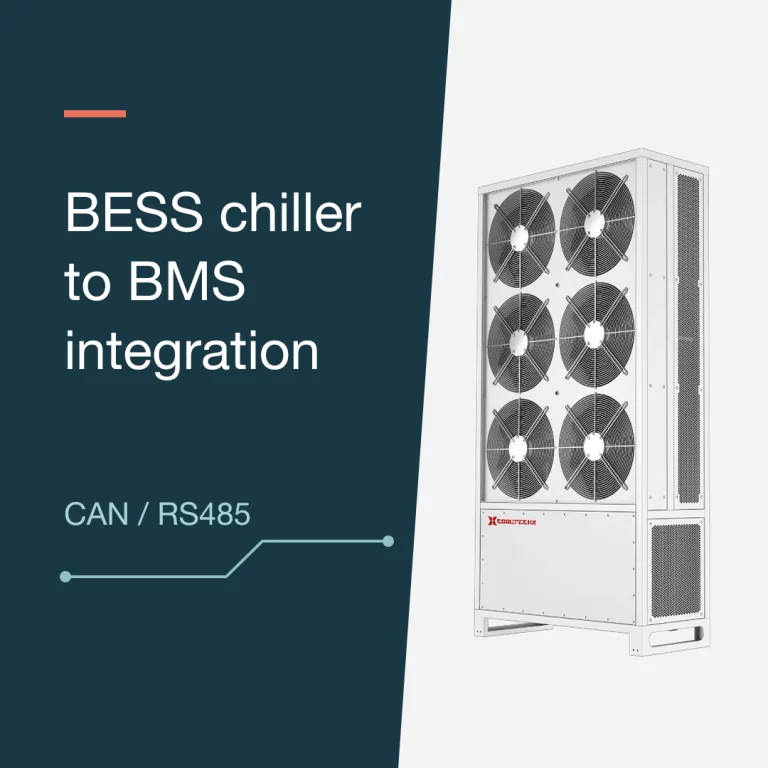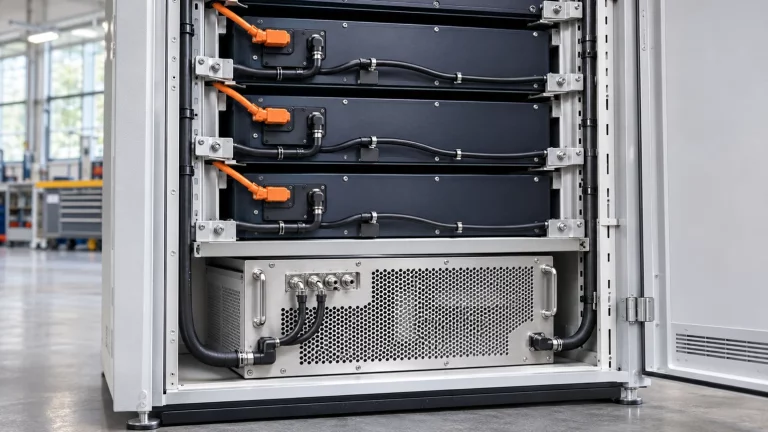

India’s battery storage pipeline now covers state-backed standalone projects as well as behind-the-meter commercial and industrial (C&I) systems. One example is the Request for Selection that SECI issued on behalf of GRIDCO for 125 MW / 500 MWh of standalone BESS in Odisha. It is tendered as tariff-based competitive bidding with viability gap funding from PSDF (RfS No. SECI/C&P/IPP/15/0015/25-26, dated 18 December 2025). For the integrators who build these systems, the liquid cooling unit largely decides whether a battery cabinet keeps its rated output on a 45 °C afternoon.
This guide covers what to specify when you buy a liquid cooling unit, often called a BESS chiller, for a project in India: heat load, design ambient, dust and humidity, the coolant loop, controls and commissioning. It ends with field references from Cooltechx projects in India and the information we need to prepare a quotation.
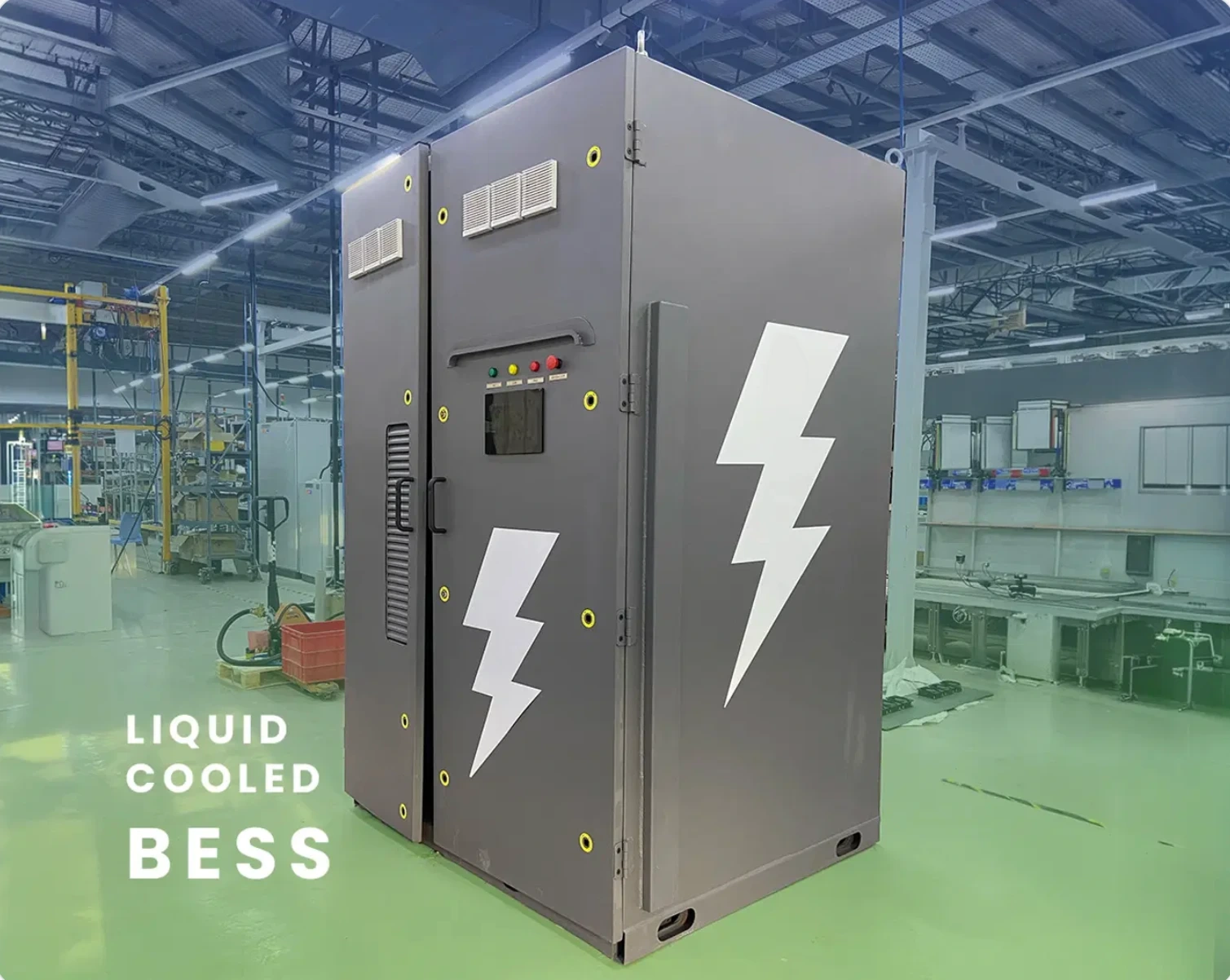
Why the cooling specification carries more risk in India
Indian sites push a cooling unit away from the conditions it was rated at in several ways.
- Heat. Pre-monsoon maximum temperatures above 45 °C occur in parts of northwest and central India. An outdoor cabinet in direct sun also runs hotter than the surrounding air. A unit rated at 35 °C ambient can deliver noticeably less cooling at 45 to 50 °C.
- Dust. Dry-season dust builds up on the condenser coil, raises condensing pressure and cuts capacity. Sites near highways, quarries and open farmland are worse.
- Monsoon humidity and coastal air. High humidity raises the risk of condensation inside the battery enclosure whenever the coolant runs below the dew point. Coastal sites, including parts of Odisha, Gujarat and Tamil Nadu, add salt corrosion on fins and fasteners.
Tender terms add a commercial layer. Standalone BESS agreements usually link payments to availability and performance over the contract term. If the round-trip efficiency definition in the RfS and the Battery Energy Storage Purchase Agreement (BESPA) includes auxiliary consumption, every kilowatt the chillers draw lowers the measured result. Read those definitions before you choose between a smaller unit running hard and a larger unit running at part load.
Air cooling or liquid cooling?
Air-conditioned enclosures still suit smaller, lower-density systems. Liquid cooling moves heat through cold plates in contact with the battery modules. That keeps the temperature spread between cells tighter and handles the dense 300 Ah-class LFP cells now used in C&I cabinets and 20 ft containers. A smaller cell-to-cell spread slows uneven ageing, which matters for a system that must hold its capacity for years. Liquid cooling has become the usual choice for high-density LFP cabinets and containers, so the rest of this guide assumes a liquid loop.
Step 1: Size the heat load from the duty cycle
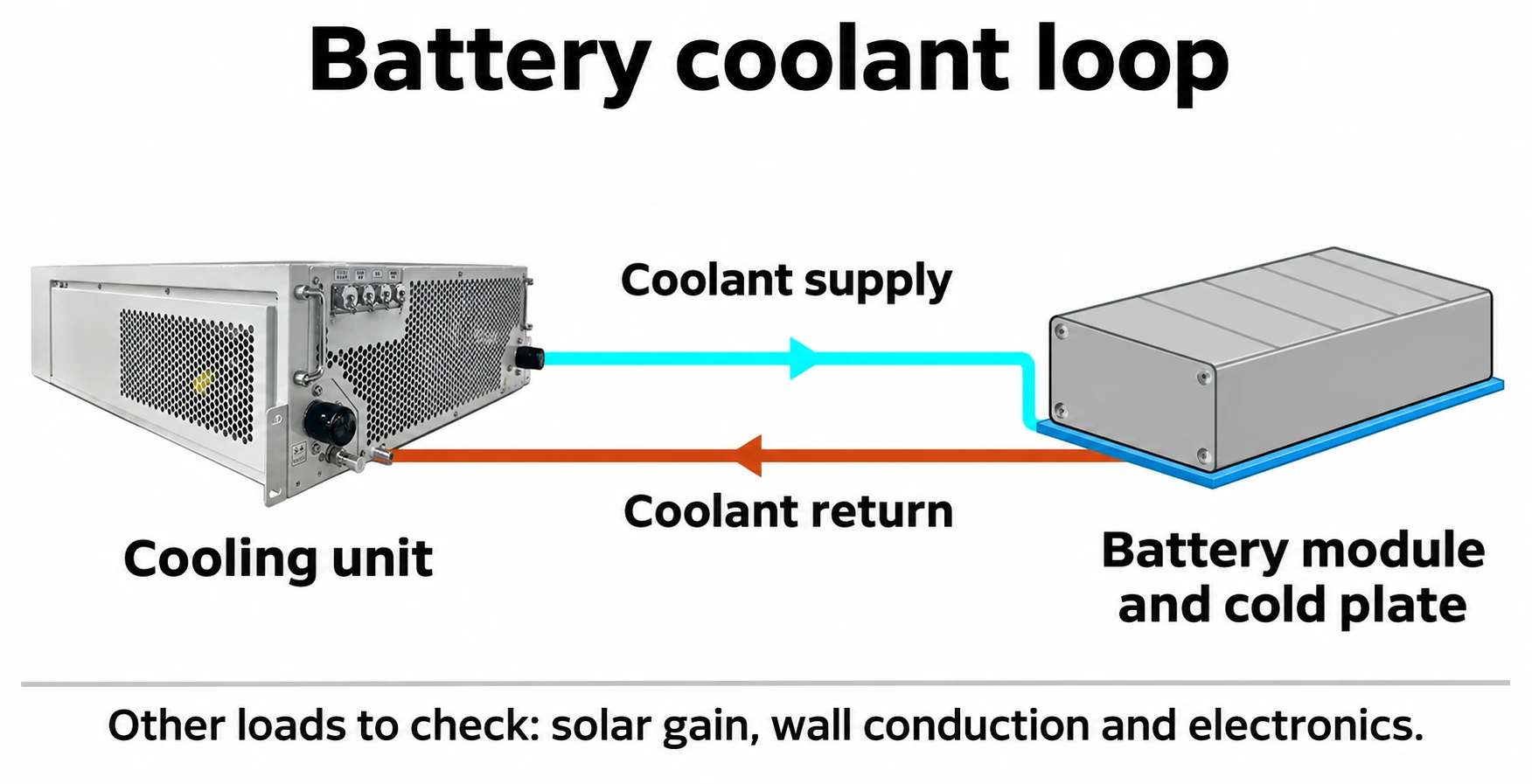
Start by fixing the boundary of the load. The liquid cooling unit always removes the heat the battery generates. Solar gain, wall conduction and heat from electronics in the enclosure air belong on the liquid loop only if the liquid cooling unit also cools the enclosure air. If a separate enclosure air conditioner does that, size the air conditioner for those gains instead. Account for these sources:
| Heat source | What drives it | Where to get the number |
|---|---|---|
| Cell, module and busbar losses | C-rate, cell internal resistance, cycle profile | Cell or battery supplier’s heat generation data at your C-rate |
| Solar gain on the enclosure | Orientation, surface colour, insulation, shading | Enclosure thermal calculation for the hottest month at site |
| Conduction through walls | Outdoor to indoor temperature difference, insulation | Enclosure supplier |
| Internal electronics | BMS, fans, pumps, lighting, any power electronics inside | Component datasheets |
The duty cycle matters as much as the energy rating. A 4-hour system such as the Odisha projects (500 MWh at 125 MW) runs at about 0.25C. Its heat generation per MWh is low, but each discharge lasts four hours. A 2-hour C&I cabinet at 0.5C generates more heat per kWh, often in the hottest part of the day when peak shaving is needed. Size the unit for the worst combination of C-rate, ambient temperature and solar load the project can actually see.
Illustrative example (assumed values, not project data): a 261 kWh cabinet discharging at 0.5C delivers roughly 130 kW. If the cell supplier states that about 3% of that power becomes heat in the pack at this rate, internal generation is about 3.9 kW. If the liquid cooling unit also removes enclosure heat, add solar and wall gains of, say, 1 kW for an insulated outdoor cabinet in Indian summer sun, and the load approaches 5 kW before margin. A unit with about 6 kW of net capacity at the site design ambient would fit this case. Replace each assumption with your supplier’s data.
Step 2: Rate capacity at your design ambient, not the catalogue point
- Ask for the capacity curve across ambient temperature at your coolant supply temperature. Nameplate capacity is usually quoted at a single test condition.
- Set the design ambient from site weather data for the hottest month. Add an allowance for hot-air recirculation if units stand close together or near a wall.
- Confirm the high-ambient limit: the temperature up to which the unit keeps running, possibly at reduced capacity, and the point at which it trips.
- Check low-ambient behaviour as well. Winter mornings in north India can be cold enough that the battery needs heating before it charges. Many liquid cooling units include an electric heater for this.
- Get the input power at design ambient, not only the cooling capacity. That number feeds your auxiliary consumption estimate.
Step 3: Specify for dust, humidity and corrosion
- Condenser coil: anti-corrosion coated fins for coastal and industrial sites, and fin spacing that can be cleaned with low-pressure air or water.
- Ingress protection: state the protection level you need for the unit and the battery compartment. Check that cable glands and pipe penetrations keep that level.
- Condensation control: the controller should keep the coolant supply temperature above the enclosure dew point, or the enclosure needs dehumidification. Ask how the unit handles monsoon conditions.
- Maintenance access: filters, coil and pump should be reachable without removing battery racks.
Step 4: Design the coolant loop as part of the battery
The refrigeration circuit is tested at the factory. The coolant loop is often assembled by the integrator or on site, so it needs its own design check.
- Flow and pressure drop: add up the pressure drop of cold plates, manifolds, hoses and fittings at the required flow. Then check that the unit’s pump delivers that flow with margin.
- Coolant: agree the glycol type and concentration. More glycol protects against freezing but reduces heat transfer and raises pressure drop.
- Piping layout: custom piping is often needed to match a cabinet’s port positions. Fix the routing, materials and connector types before the unit ships.
- Filling and air purge: trapped air starves some modules of flow. Specify high-point vents and a filling procedure.
- Leak protection: pressure-test the assembled loop and decide where leak sensors go.
Step 5: Agree controls and BMS communication early
The cooling unit should take its setpoints and run commands from the BMS or EMS and report alarms back. Agree the protocol (Modbus RTU, Modbus TCP and CAN are common), the register map, the alarm list and what the unit does if communication is lost. For utility-scale containers with several units, decide on redundancy, for example whether the remaining units can carry a container at reduced power if one fails.
C&I cabinets versus utility-scale containers
| C&I BESS cabinet | Utility-scale container | |
|---|---|---|
| Unit placement | Integrated into the cabinet base, side or top | Container end wall, roof or separate skid |
| Main selection concerns | Compact size, noise near occupied buildings, simple installation | Capacity at high ambient, redundancy, auxiliary consumption across the fleet |
| Who checks the result | Integrator and site owner | Developer, lender’s engineer and tender performance tests |
| Cooltechx range | C&I BESS liquid cooling | Utility-scale BESS liquid cooling |
Field references from India
The details below come from specific Cooltechx installations and demonstrations. They describe what was supplied and tested on those projects and are not general ratings for every application.
6 kW unit for a C&I BESS project
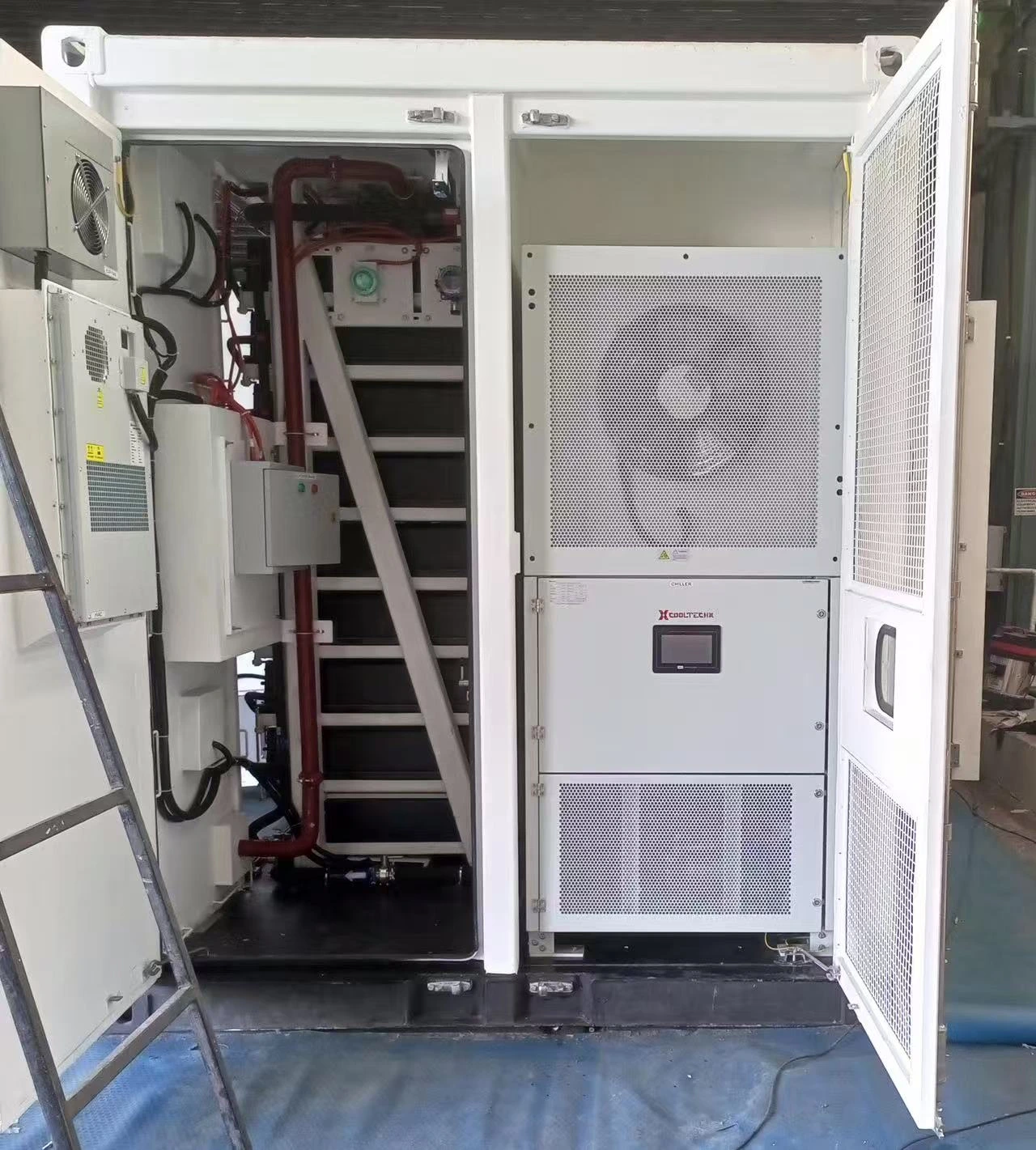
Cooltechx installed and tested a 6 kW liquid cooling unit with custom piping on a commercial and industrial BESS project in India. On site, the team checked coolant circulation and the piping connections. The published report does not include test measurements. Read the project report.
20 kW unit for high-ambient operation
For another energy storage project in India, Cooltechx supplied a 20 kW liquid cooling unit with a custom circulation loop. The client required operation at high ambient temperatures, which means the unit has to be checked against its capacity curve at the site design temperature. Read the project report.
261 kWh cabinet at an India expo
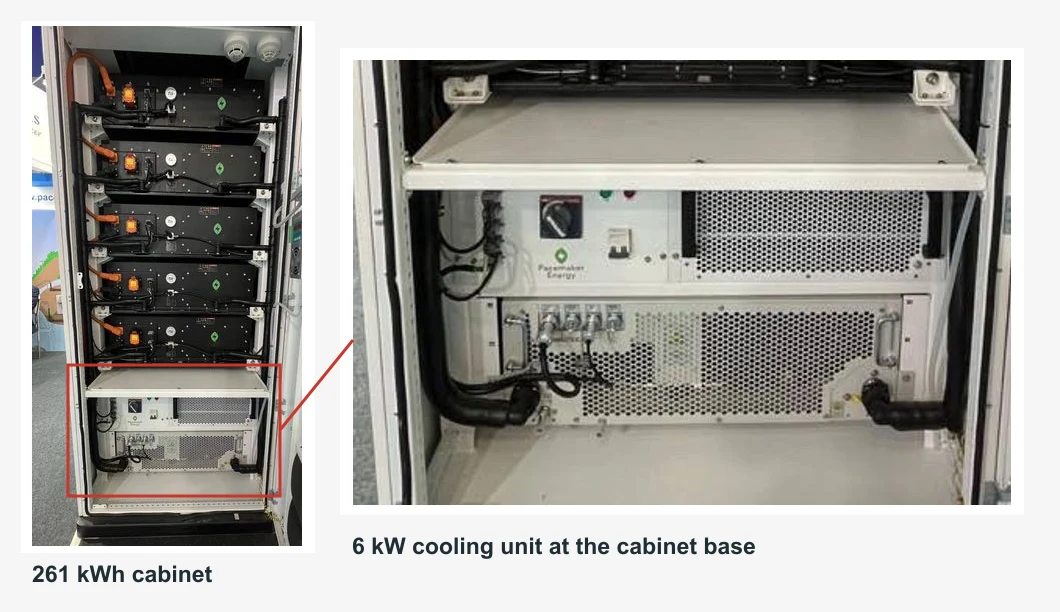
At an expo in India, a 261 kWh energy storage cabinet was shown with a Cooltechx 6 kW liquid cooling unit mounted in its base. See the expo showcase.
Commissioning checklist
- Pressure-test the assembled coolant loop and record the hold result.
- Fill the loop, purge air at the high points and confirm the coolant concentration.
- Check flow and pressure at the unit against the design values.
- Confirm BMS or EMS communication, setpoint changes and every alarm, including loss of communication.
- Run the battery through a charge and discharge cycle at the highest available C-rate and log cell temperatures and their spread.
- Record the unit’s input power during that cycle for the auxiliary consumption baseline.
- Check condenser airflow clearances and coil condition, and hand over a cleaning schedule for the dust season.
What to send us for a quotation
Use the inquiry form at the bottom right of this page. If you include the following, our engineers can reply with a sized proposal instead of a catalogue:
- Project location and design ambient temperature (maximum and minimum)
- Project type (C&I or utility-scale) and battery energy per cabinet or container
- Power rating or C-rate, and cycles per day
- Cell supplier heat generation data, target coolant supply temperature and allowed cell temperature window
- Cold plate flow requirement and pressure drop, and cabinet port positions if you need custom piping
- Whether the liquid cooling unit also removes enclosure heat or a separate air conditioner handles it
- Available power supply for the cooling unit
- BMS or EMS communication protocol
- Any tender clauses on auxiliary consumption or round-trip efficiency
- Quantity and required delivery date
You can also browse the full energy storage cooling range.
FAQ
What size liquid cooling unit does a 261 kWh BESS cabinet need?
It depends on the C-rate, the cell heat generation data and the site ambient. In one demonstration in India, a 261 kWh cabinet used a 6 kW unit. Use the sizing steps above to check your own case.
Can a BESS liquid cooling unit run at 50 °C ambient?
Some units are designed to keep running at high ambient temperatures with reduced capacity. Ask the supplier for capacity and input power at your design ambient and for the temperature at which the unit trips.
Does the cooling unit’s power consumption affect tender performance?
It can. If the RfS and BESPA define round-trip efficiency to include auxiliary consumption, the chillers’ power draw lowers the measured figure. Check the definition in your tender documents and include the unit’s input power at design ambient in your calculation.
Is custom piping available?
Yes. Both India project references above used custom piping or a custom circulation loop matched to the battery system.