

Liquid-cooled battery energy storage systems (BESS) still produce noise. Condenser fans, compressors and circulation pumps remain sound sources. The level reaching nearby homes depends on operating load, distance, layout and the other equipment running on site.
This guide covers BESS cooling noise data, UK, EU and U.S. assessment considerations, practical noise controls, and the information needed to select a low-noise chiller for commercial and industrial (C&I) storage.
How loud is a BESS cooling system?
There is no single noise level that applies to every BESS cooling system. The result depends on the equipment, operating duty and measurement method. A chiller’s sound-pressure level at a stated distance is different from the combined sound level reaching a nearby home.
For a specific equipment example, Cooltechx’s 4+3 kW low-noise chiller lists ≤60 dB(A) at 25°C with rated capacity output. That is a product specification under stated conditions, not a site-boundary limit. The product section below explains the additional acoustic data needed before using it in a project assessment.
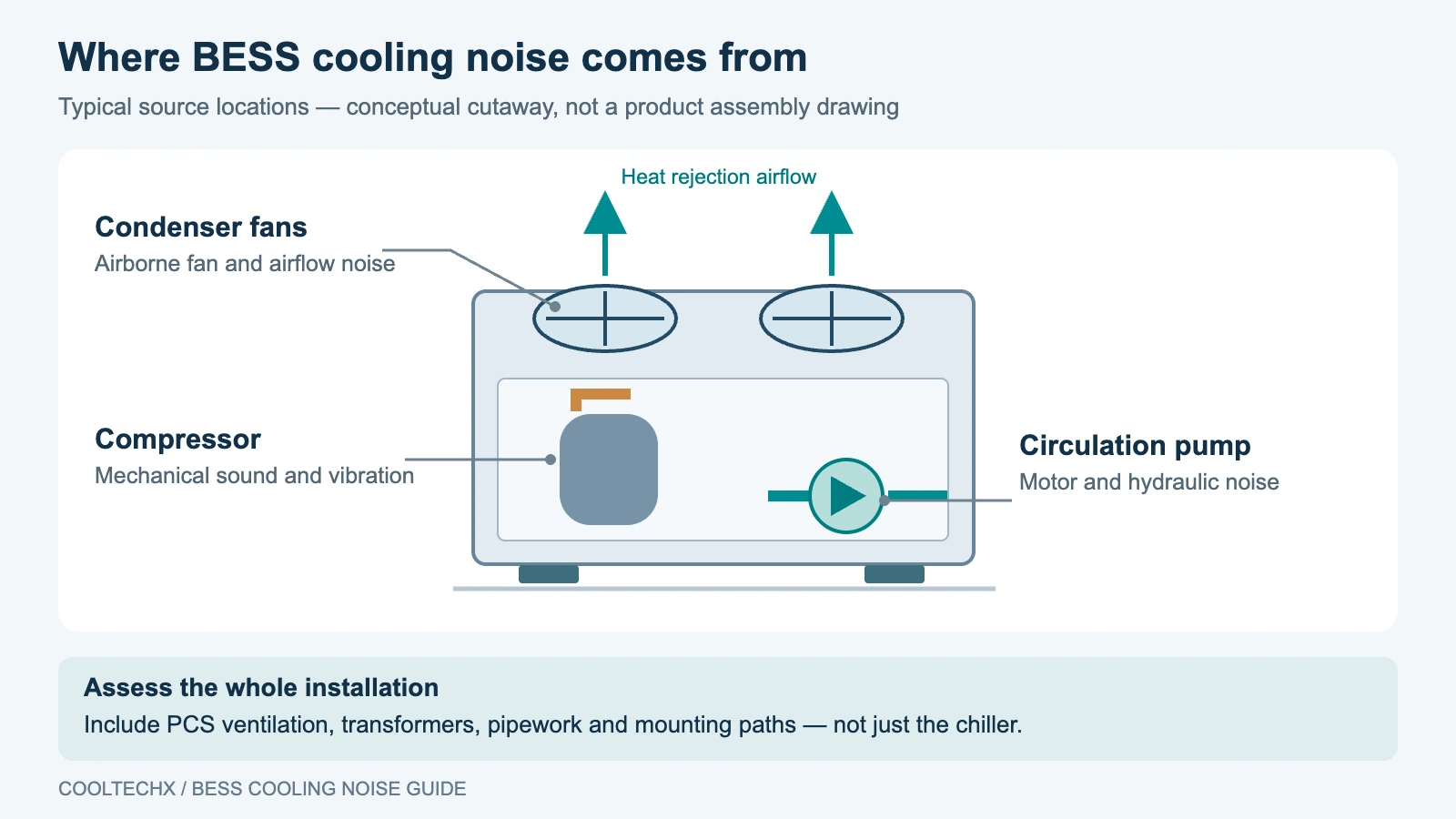
Why liquid-cooled BESS still produces noise
Liquid cooling moves heat away from batteries through a coolant circuit. It does not eliminate the equipment needed to reject that heat. Depending on the system, condenser fans, compressors and pumps remain sound sources. The complete installation may also include ventilation for the power conversion system (PCS) and transformers.
Scotland’s BESS planning guidance identifies cooling equipment, inverters and transformers as noise sources and highlights the combined effect of multiple containers and nighttime operation. That makes a whole-site assessment more useful than evaluating the chiller in isolation. Scottish BESS planning guidance.
A quiet chiller does not necessarily make a quiet BESS installation. At a nearby home, sound from the chillers, PCS ventilation and transformers combines. Adding more cabinets can raise the total noise level even when each cabinet uses the same low-noise equipment.
Why chiller noise ratings are not always comparable
Two values expressed in dB(A) may describe different things. Sound pressure describes the sound at a measurement position; sound power describes acoustic emission from the source under the stated conditions. Distance and surroundings affect sound pressure. A-weighting describes frequency weighting and does not, by itself, identify which quantity is being reported. CCOHS: Noise—Basic Information.
| What the noise specification states | What it resolves |
|---|---|
| Sound pressure or sound power, with the measurement standard | Whether competing specifications are directly comparable |
| Distance, microphone positions, equipment orientation and test environment | What a reported sound-pressure figure actually represents |
| Ambient and coolant temperatures, cooling output and operating mode | Whether the test covers the intended thermal duty |
| Fan, compressor and pump operating conditions | Whether the result represents reduced-speed or higher-output operation |
| Frequency-band data and information on tonal characteristics | What the acoustic assessor can use beyond a single overall number |
| Test report, configuration and measurement uncertainty | Whether the evidence applies to the equipment being purchased |
A lower quoted number does not always mean a quieter chiller. A sound-pressure result measured at 10 m cannot be directly ranked against one measured at 1 m, because distance affects the result. Differences in cooling output, operating mode and test environment can also make two headline values misleading.
What noise limits apply to BESS projects?
Noise at the site boundary can differ from noise at a nearby bedroom facade. A requirement therefore needs an assessment location, an operating period and a defined sound metric to be meaningful. The number measured beside a chiller does not, by itself, describe the sound reaching a neighbouring home.
How far away can BESS noise be heard?
There is no universal distance beyond which BESS noise becomes inaudible. Audibility depends on source levels and frequency content, the number of operating units, background sound, equipment orientation, terrain, barriers and weather. An acoustic assessment should predict sound at the actual nearby receivers; a catalogue dB(A) value alone cannot establish a suitable setback. The BS 4142 implementation guidance explains the importance of source directivity, propagation conditions, screening and measurement uncertainty.
UK projects: how BS 4142 assesses industrial sound
BS 4142 assesses industrial and commercial sound by comparing a rating level with background sound and considering context. Audible tonal or intermittent features can affect the rating. The Environment Agency’s implementation guidance also stresses uncertainty and does not treat a single difference above background as universally acceptable. Planning conditions are project-specific; this environmental-permitting guidance is not itself a universal BESS planning condition. BS 4142 implementation guidance.
For Scottish projects, the BESS planning guidance recommends early discussion with Environmental Health Officers on assessment methodology and criteria. It also describes assessment using full-capacity plant emissions unless an alternative approach is agreed with the planning authority. Scottish assessment guidance.
EU projects: why limits vary by location
The EU Environmental Noise Directive does not set a universal environmental noise limit. Applicable limits instead depend on national and local requirements and project conditions, including the assessment location and nighttime period. European Commission: Environmental Noise Directive.
U.S. projects: state and local noise requirements
U.S. BESS noise requirements depend on state and local rules and the site’s permit conditions. The EPA explains that primary responsibility for many community noise issues rests with state and local governments. The receiving location, land-use classification, nighttime period and measurement method determine how a local requirement applies. EPA: the role of state and local governments in noise control.
For example, Washington’s WAC 173-60-040 sets a base limit of 60 dBA for a Class C source affecting a Class A receiving property, with a 10 dBA reduction from 10 p.m. to 7 a.m. That gives a 50 dBA nighttime base limit for that classification pair, before applicable adjustments or exemptions. This is a jurisdiction-specific example, not a nationwide BESS limit or a chiller test specification. Different classifications, local rules and permit conditions can produce different requirements, so a generic 45–55 dBA nighttime range cannot represent every project.
How multiple cabinets increase total BESS noise
Decibels are logarithmic. For independent sources running simultaneously and making equal contributions at the same receiver, doubling their number increases the combined level by approximately 3 dB. The following is an illustrative calculation, not measured Cooltechx performance or a prediction for a particular site. CCOHS explanation of decibel addition.
| Simultaneous equal sources | Each source’s contribution at the receiver | Combined contribution |
|---|---|---|
| 1 | 40 dB(A) | 40 dB(A) |
| 2 | 40 dB(A) | 43 dB(A) |
| 4 | 40 dB(A) | 46 dB(A) |
| 8 | 40 dB(A) | 49 dB(A) |
The 40 dB(A) input is each source’s contribution at the same receiver. It is neither a limit nor a measurement beside the machine. In a real layout, cabinet distances, orientation and screening differ. The acoustic model must combine those different contributions with the other relevant site sources.
The chiller is only one contributor to the total sound level. Quieter cooling equipment can reduce that contribution, while PCS ventilation, transformers and other operating units still affect the result. This is why a low chiller rating alone cannot establish whole-site noise performance.
How to reduce BESS cooling noise
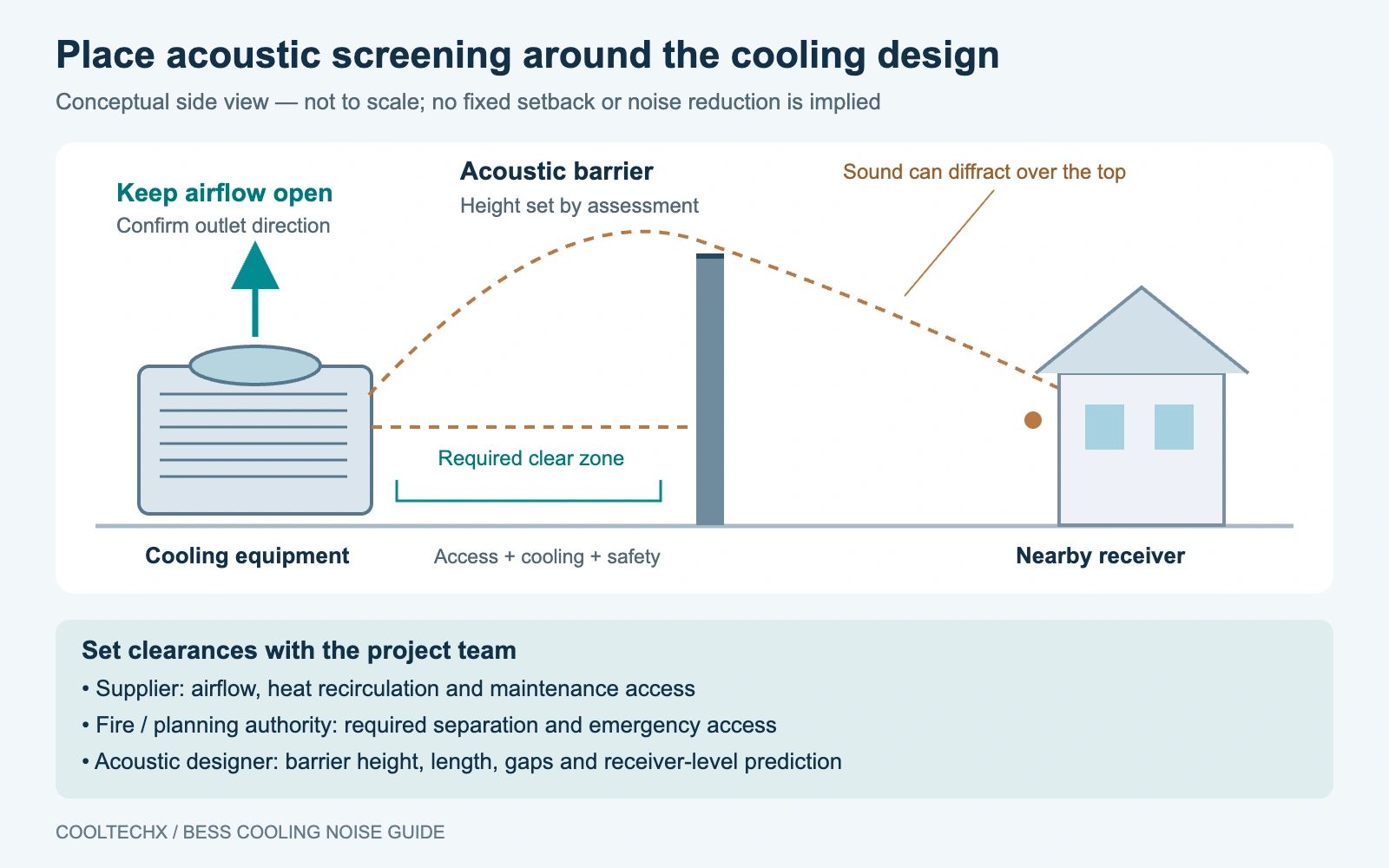
Source treatment, barriers and vibration isolation address different noise paths. An enclosure or barrier needs an appropriate design; gaps and necessary ventilation openings can limit its effectiveness. OSHA Technical Manual: noise-control engineering.
Noise reduction works by reducing sound at its source, limiting its path to nearby receivers, or reducing vibration transmitted into the installation:
- Operating speed and cooling output. Reduced fan or compressor speed can lower noise, but it can also reduce available cooling capacity. A low-noise rating is meaningful only alongside the cooling output and operating conditions at which it was measured.
- Distance and orientation. Equipment position and outlet direction affect the sound reaching nearby homes. Increasing separation can help, although reflections, terrain and other sound paths also influence the result.
- Acoustic barriers. Screening can reduce sound reaching a receiver, but a poorly placed barrier can restrict airflow or recirculate hot discharge air. Barrier design therefore has to account for heat rejection, emergency access and required safety clearances.
- Vibration isolation. Mechanical vibration can travel through supports and pipe connections. Suitable isolators and compatible connection details reduce this transmission path; an acoustic barrier alone does not address it.
- Maintenance access. Fans, heat exchangers, pumps and connections still need servicing after acoustic treatment is installed. A screen that prevents access makes routine maintenance harder.
Scotland’s planning guidance identifies layout, low-noise equipment and acoustic screening as mitigation options, with attention to safety and access. The reduction achievable with any package needs project-specific assessment. BESS noise mitigation guidance.
Why nighttime noise control can affect cooling capacity
Where supported by the controller, a nighttime mode can use lower fan or compressor speeds to reduce noise. Its cooling capacity is still tied to ambient temperature, battery load and PCS load. The same reduced-speed setting may be sufficient under light load but insufficient when more heat needs to be removed.
If thermal demand exceeds the capacity available in that mode, higher equipment speeds may be needed, changing the noise level. A fixed low fan speed therefore cannot guarantee both temperature control and a nighttime noise target under every condition. The relationship between operating commands, feedback and thermal protection is explained in BMS and chiller control integration.
Where Cooltechx’s 4+3 kW low-noise chiller fits
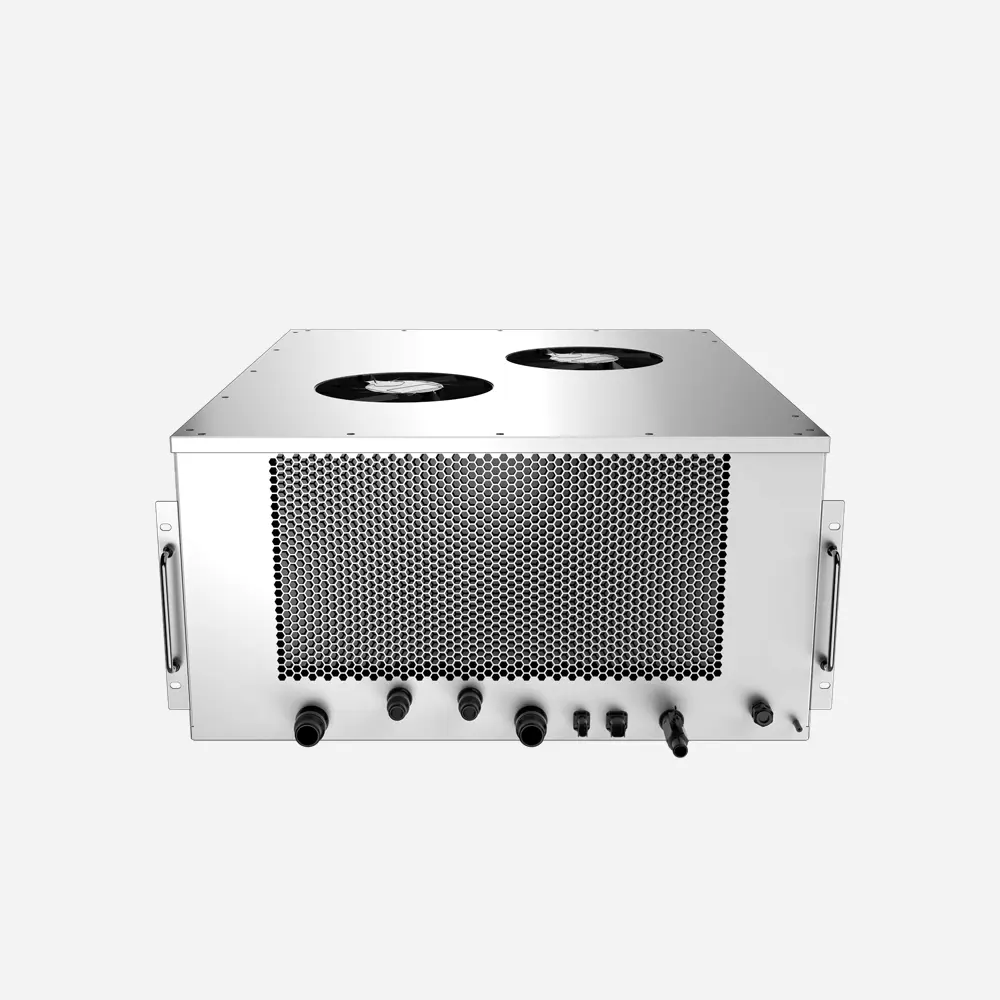
The Cooltechx 4+3 kW low-noise C&I BESS liquid cooling chiller provides separate battery PACK and PCS coolant circuits. Its published specification lists:
- Battery-side cooling: 4 kW at 50°C ambient, 50% RH and 18°C battery inlet-water temperature.
- PCS-side cooling: 3 kW at 50°C ambient, 50% RH and 55°C PCS inlet-water temperature.
- Noise: ≤60 dB(A) at 25°C with rated capacity output.
The cooling-capacity conditions and noise condition are different: the 25°C noise figure does not establish performance at 50°C. The published noise entry also does not state the measurement quantity, distance where applicable, test method or frequency-band data. It therefore provides a product reference value, but not enough information on its own to predict noise at a nearby home.
What to include in a low-noise BESS cooling enquiry
A useful enquiry connects the thermal requirement to the acoustic requirement. Send the following information with the layout drawing:
- Project location and acoustic brief: assessment positions, applicable periods, required metric and project-specific target.
- Equipment schedule: cabinet quantity, chiller quantity, PCS and transformer arrangement, plus future expansion.
- Thermal duty: separate PACK and PCS heat loads, coolant targets, flow requirements and design ambient conditions.
- Operating schedule: charging and discharging periods, expected nighttime duty and any agreed operating restrictions.
- Installation details: equipment orientation, nearby walls, available clearances, mounting and proposed acoustic treatment.
- Acceptance requirements: supplier test evidence, final configuration, on-site measurement conditions and responsibility for verification.
What on-site noise measurements reveal
On-site measurements show how the combined installation behaves at the actual assessment locations. Their meaning depends on which units are running, their operating modes, thermal loads and ambient conditions. A measurement with only one lightly loaded chiller operating cannot establish the noise level of all units running at a higher duty.
Differences between predicted and measured levels can arise when the installed cabinet quantity, outlet direction, screening or control settings differ from the acoustic model. For a nighttime mode, sound measurements and cooling-performance data describe the trade-off more fully than either result alone.
BESS cooling noise FAQ
Does a 60 dB(A) BESS chiller meet UK BS 4142 residential limits?
Not on that figure alone. BS 4142 does not provide a single residential pass/fail limit. Assessment considers the rating level at the receiver, background sound, acoustic features, context and uncertainty. A supplier’s 60 dB(A) figure needs its test conditions and measurement quantity before it can inform the site assessment.
Why does a liquid-cooled BESS still make noise?
Liquid cooling transfers heat through coolant, but heat rejection can still require condenser fans, compressors and circulation pumps. PCS ventilation and transformers may add to the total. The total depends on which sources are operating together and at what duty.
Can an acoustic barrier reduce BESS cooling noise?
A properly designed barrier can reduce sound reaching a receiver, but its performance depends on geometry, frequency content, gaps and other sound paths. The design must also preserve airflow, maintenance access and required safety separation; blocking heat rejection can compromise cooling performance.
What nighttime noise limit applies to a BESS in the United States?
The applicable limit depends on state and local rules and site permit conditions. Source and receiving land uses, assessment location, time period and sound metric all affect how the requirement applies. A generic 45–55 dBA range is not a nationwide BESS requirement.
What acoustic data should I request for a low-noise BESS chiller?
Useful acoustic data identifies the sound quantity, test standard, measurement distance where applicable, frequency-band levels, acoustic characteristics and uncertainty. The cooling output, ambient and coolant temperatures, and fan, compressor and pump operating conditions show which operating state the result represents.
Planning a noise-sensitive C&I storage project? Review Cooltechx’s C&I BESS liquid cooling systems and send your thermal duty, site layout and acoustic brief through the product enquiry form. Use those inputs to establish which configuration and supporting test data are appropriate for your project.


