

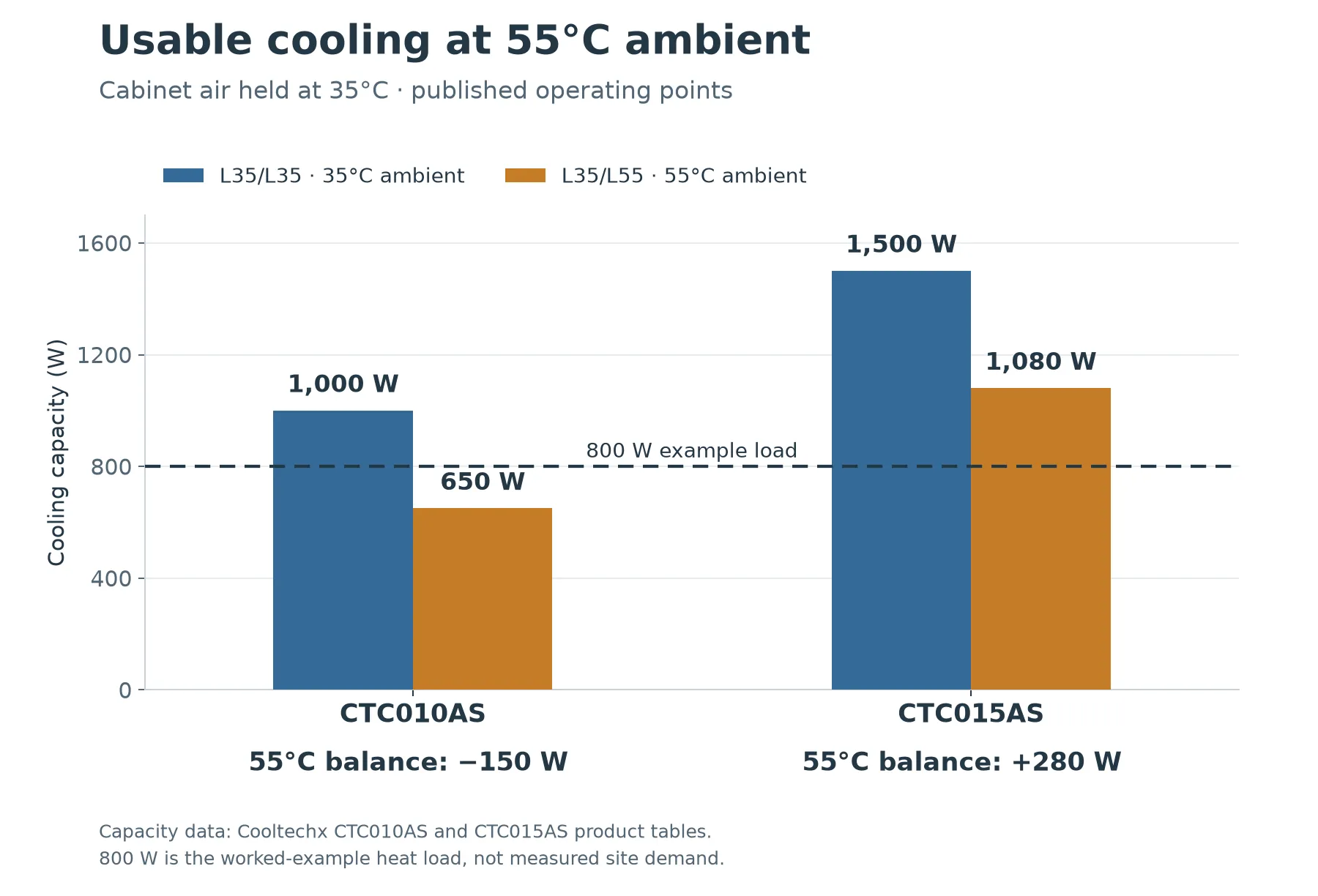
At 55°C ambient, use the cooling capacity published for the actual cabinet and outdoor temperatures: an operating limit of 55°C is not a full-capacity rating at 55°C. With cabinet air held at 35°C, the two published examples below fall from 1,000 W to 650 W (−35%) and from 1,500 W to 1,080 W (−28%) as ambient rises from 35°C to 55°C. Compare the L35/L55 value with the required cooling duty; the reduction is specific to each model.
High-ambient enclosure air conditioner ratings: operating limit versus capacity
An operating-temperature limit answers whether the unit is specified to run under that environmental condition. A cooling-capacity rating answers how much heat it can remove at a particular pair of internal and external temperatures. A “+55°C” operating limit is not a promise of nominal cooling output throughout the operating range.
Selecting against the rating at the design ambient condition is standard practice for outdoor installations. The higher-ambient row states the cooling capacity available under that temperature condition; compare it with the established cooling duty before selecting a unit.
Published capacity: L35/L35 versus L35/L55
The following Cooltechx parameter tables provide two worked examples of reading these ratings. Both hold internal cabinet air at 35°C while external ambient changes.
| Model and published data | Capacity at L35/L35 | Capacity at L35/L55 | Capacity lost | Percentage lost | Capacity retained |
|---|---|---|---|---|---|
| Cooltechx CTC010AS | 1,000 W | 650 W | 350 W | 35% | 65% |
| Cooltechx CTC015AS | 1,500 W | 1,080 W | 420 W | 28% | 72% |
Calculate the reduction against the original rating:
Capacity loss (%) = (Q35 − Q55) ÷ Q35 × 100
- CTC010AS: (1,000 − 650) ÷ 1,000 × 100 = 35%.
- CTC015AS: (1,500 − 1,080) ÷ 1,500 × 100 = 28%.
These percentages apply to the two published operating points for each model. Use a published rating for each design condition rather than interpolating or extrapolating from this comparison.
Why hotter ambient reduces cooling capacity
The condenser must reject cabinet heat plus the energy added by the compressor. Its heat-transfer driving force is approximately the difference between refrigerant condensing temperature and incoming outdoor air temperature:
Condenser ΔT = refrigerant condensing temperature − condenser inlet air temperature
At an unchanged condensing temperature, hotter inlet air reduces this difference. To reject heat, the refrigeration circuit generally operates at a higher condensing temperature and pressure. The compressor then works against a greater pressure ratio, increasing compression work and typically electrical input while reducing cooling efficiency.
Depending on compressor design and controls, the higher pressure ratio can also lower volumetric efficiency and refrigerant mass flow. Changes in refrigerant state reduce the cooling effect available per unit mass. Together, these mechanisms explain why continued compressor operation does not mean unchanged cooling output.
Condenser ΔT uses refrigerant condensing temperature and condenser inlet air temperature. It is distinct from the 20°C difference between cabinet air and outdoor air in this example.
How to read the datasheet before locking in a model
For these Cooltechx tables, L35/L35 means 35°C internal air and 35°C ambient air; L35/L55 means 35°C internal air and 55°C ambient air. Always check the manufacturer’s notation and measurement definitions rather than assuming every datasheet uses the same order.
| Datasheet item | Reading rule | Selection error it prevents |
|---|---|---|
| Operating-temperature range | Read it as the stated operating envelope, subject to the manual’s conditions. | Treating +55°C capability as full output at +55°C. |
| Cooling capacity at L35/L35 | Use it only for the stated 35°C/35°C condition. | Comparing nominal capacity with a high-ambient requirement. |
| Cooling capacity at L35/L55 | Use this row for the stated 35°C/55°C condition. | Overstating available cooling by 350 W or 420 W in these examples. |
| Internal temperature definition | Match the rating’s cabinet-side air reference to the design condition. | Treating a controller setpoint or a local hot spot as the rating temperature. |
| Electrical version and rating notes | Match supply, frequency, and the exact version to its performance data. | Transferring performance to a version that has not been verified. |
At the same outdoor temperature, allowing warmer cabinet air—for example, 40°C rather than 35°C—generally increases available cooling capacity in a fixed-speed refrigeration system; requiring cooler cabinet air, such as 25°C, generally reduces it. Warmer return air permits a higher evaporating temperature and a lower compressor pressure ratio. Read the capacity table for the actual cabinet-air target and check component temperature limits; the two L35 ratings quantify only the 35°C cabinet condition. The same operating-point check applies if condenser inlet air exceeds 55°C.
Use our cabinet air conditioner sizing guide to calculate total heat load, including the relevant cabinet and environmental contributions. Here, that result is an input: the next step is checking whether the published usable capacity covers it.
Worked example: an 800 W cooling requirement at 55°C
Example assumptions: total heat load is 800 W, cabinet-side rating air is 35°C, and condenser inlet ambient is 55°C. The installed electrical version and airflow match the published rating conditions. The 800 W duty and later 15% allowance are illustrative design inputs; the capacity values come from the product tables. This is a steady-state capacity check, with component temperatures and installed performance checked during commissioning.
First compare available capacity directly with required duty:
Capacity balance = published capacity at L35/L55 − required cooling duty
CTC010AS:
- Available cooling = 650 W.
- Capacity balance = 650 − 800 = −150 W.
- Shortfall relative to load = 150 ÷ 800 × 100 = 18.75%.
A selection based on the 1,000 W headline would appear to have 200 W spare. At the specified hot operating point it instead has a 150 W deficit, so the unit cannot maintain the 35°C rating condition in steady state under the stated assumptions.
CTC015AS:
- Available cooling = 1,080 W.
- Capacity balance = 1,080 − 800 = +280 W.
- Spare capacity relative to load = 280 ÷ 800 × 100 = 35%.
This model covers the assumed 800 W duty at the published operating point, with 280 W available above the load.
If a project explicitly requires an additional 15% capacity allowance, apply that stated assumption to the load:
Required capacity = 800 × 1.15 = 920 W
At L35/L55, 650 W is 270 W below that requirement; 1,080 W is 160 W above it. Apply the allowance once, checking whether it is already included in the supplied cooling-duty figure.
Field diagnostics: expected derating or an installation problem?
Measure ambient air where it enters the condenser. A weather reading away from the cabinet may miss hot exhaust recirculation. Measure cabinet-side air at the rating reference location where defined, and separately check critical component inlet temperatures.
Use the checks below to distinguish likely causes before assigning a fault.
| Observed symptom | Possible cause | Check that separates the causes |
|---|---|---|
| Compressor runs continuously and cabinet air rises above target during hot conditions | Required duty exceeds capacity at the actual operating point; restricted airflow can produce similar symptoms. | Compare the established heat load with the matching published rating, then inspect both air paths. |
| Condenser inlet air is hotter than the surrounding site air | Exhaust recirculation, nearby heat sources, or obstructed discharge. | Measure inlet and surrounding temperatures during operation; inspect discharge routing and manual clearances. |
| Performance worsens over time at similar load and inlet temperatures | Fouled condenser, blocked filter where fitted, or deteriorating fan operation. | Inspect and service according to the manual; compare temperatures again under similar conditions. |
| Cabinet return air is acceptable but one drive or power supply overheats | Local airflow bypass, blocked equipment inlets, or concentrated heat. | Compare component inlet temperatures with cabinet return air and inspect internal circulation. |
| Unit stops or cycles while cabinet air remains hot | A protective trip, control condition, supply issue, or refrigeration fault. | Read the actual controller event code and corresponding manual procedure; verify supply and airflow. |
A continuously running compressor can be responding normally to a sustained load. Repeated protective trips require investigation using the model’s documented fault procedure and limits.
Commissioning checklist
- Record the exact unit version and its published L35/L55 capacity.
- Measure condenser inlet air and cabinet-side reference air during the hottest relevant operating condition.
- Compare the previously established cooling duty, including any explicit allowance, with 650 W or 1,080 W for these respective examples at 35°C/55°C.
- Check condenser cleanliness, fan operation, discharge clearance, and internal air distribution against the installation manual.
- Record temperature trends and controller events against the documented operating conditions and equipment limits.
The selection rule is straightforward: match the temperature pair first, then compare the published cooling capacity with the required duty. For a 35°C cabinet target at 55°C ambient, L35/L55 is the relevant rating; the operating-temperature limit and nominal wattage answer different questions.


