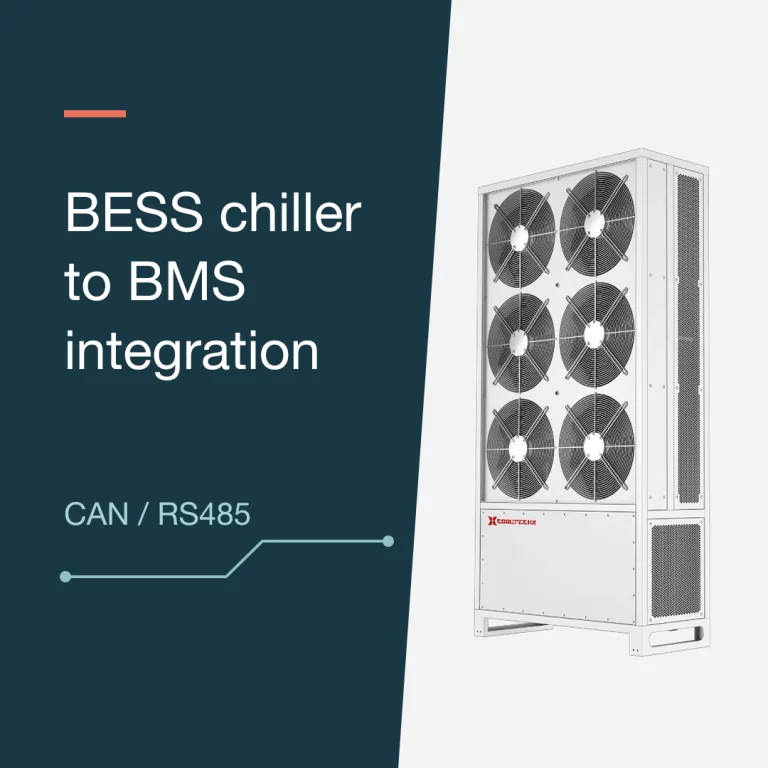

If you are ordering a new stationary liquid chiller for a battery energy storage system (BESS), R410A is above the GWP limit in both markets covered here. In the EU, the limit applies to new chillers above 12 kW first placed on the market from 1 January 2027. In the US, it applies to new industrial process refrigeration (IPR) chillers from 1 January 2026, judged by manufacture or import date for factory-made products and by installation date for systems assembled on site. The table below sets out which equipment each rule covers. Changing refrigerant also changes the chiller’s design, its safety class and the documents you should request.
The EPA Technology Transitions GWP reference table lists R32 at 675 and R410A at 2088. Annex I of Regulation (EU) 2024/573 gives the same 100-year value of 675 for HFC-32, and 3500 for HFC-125. R410A is a 50/50 blend of the two by mass, so the Annex VI weighted-average method gives 2087.5, conventionally 2088. R410A is therefore above both the US limit of 700 and the EU limit of 750, and R32 is below both. A refrigerant’s GWP is only part of the question. Whether a particular chiller can be installed at your site depends on that model’s own certification.
Which new chillers each rule covers
| Item | EU | US |
|---|---|---|
| Legal text | Regulation (EU) 2024/573, Article 11 and Annex IV | EPA Technology Transitions restrictions by sector |
| Scope | Stationary chillers above 12 kW rated capacity | New IPR chillers, as products or systems, with exiting fluid above −30 °C |
| Limit | GWP 750 or more prohibited | GWP 700 or more restricted |
| Date | 1 January 2027 | 1 January 2026 |
| Trigger | First placing of the product on the EU market | Manufacture or import date for a factory-made product; installation date for a system assembled or charged on site |
| Exception | A higher-GWP gas is required to meet safety requirements at the site of operation | No BESS-specific extension |
Neither deadline follows the purchase order date. In the EU the test is when the chiller is first placed on the market, which is not necessarily the date it ships or reaches site. Chillers already installed can keep operating under this provision. Servicing and recharging are covered by other parts of the regulation.
Small chillers have a stricter limit. Under Annex IV point 7(b), stationary chillers with a rated capacity up to and including 12 kW that contain or rely on fluorinated gases with a GWP of 150 or more cannot be first placed on the EU market from 1 January 2027, unless such a gas is required to meet safety requirements at the site of operation. The limit of 750 for chillers above 12 kW is a separate entry, point 7(d). R32, at GWP 675, therefore passes the GWP check for an 80 kW chiller but generally fails it for a 6 kW auxiliary chiller first placed on the market from that date. If a project also buys small units, check each unit’s rated capacity and classification on its own.
A procurement case: one frame order, two markets
Take an EPC that orders twelve 80 kW-class chillers in November 2026 under one frame contract, six for a project in Texas and six for a project in Spain. The order date alone does not establish when each unit is manufactured, imported or first placed on the market, so this case assumes each US unit is manufactured or imported after 1 January 2026 and each Spanish unit is first placed on the EU market after 1 January 2027.
The US units are packaged and factory-charged. On site, the installer connects glycol piping and power, which is not field refrigerant charging. Each unit is therefore normally read against EPA’s product row and judged by its manufacture or import date, which on the assumption above makes an R410A unit restricted. The EPC should not assume every BESS chiller is an IPR chiller under EPA’s definitions. Its compliance team should settle the classification and state it in the RFQ. SNAP Final Rule 26 lists HFC-32 as acceptable in new IPR chillers, subject to use conditions on safety standards and marking. State and local codes and the authority having jurisdiction (AHJ) add their own A2L requirements.
For the Spanish units, first placing on the EU market after 1 January 2027 means an R410A unit is prohibited. If the chillers ship already fitted to battery containers, the EPC should confirm with its adviser how the rule applies to the assembled product. The safe working assumption is that the chiller inside must comply.
What changes with R32, and what evidence to ask for
R410A is safety class A1, meaning lower toxicity and no flame propagation. R32 is A2L, meaning lower toxicity and mildly flammable. R32 also runs at different pressures and higher discharge temperatures, so an R410A chiller cannot simply be recharged with it. An R32 chiller is a separate configuration, with its own compressor, expansion device, charge and control settings.
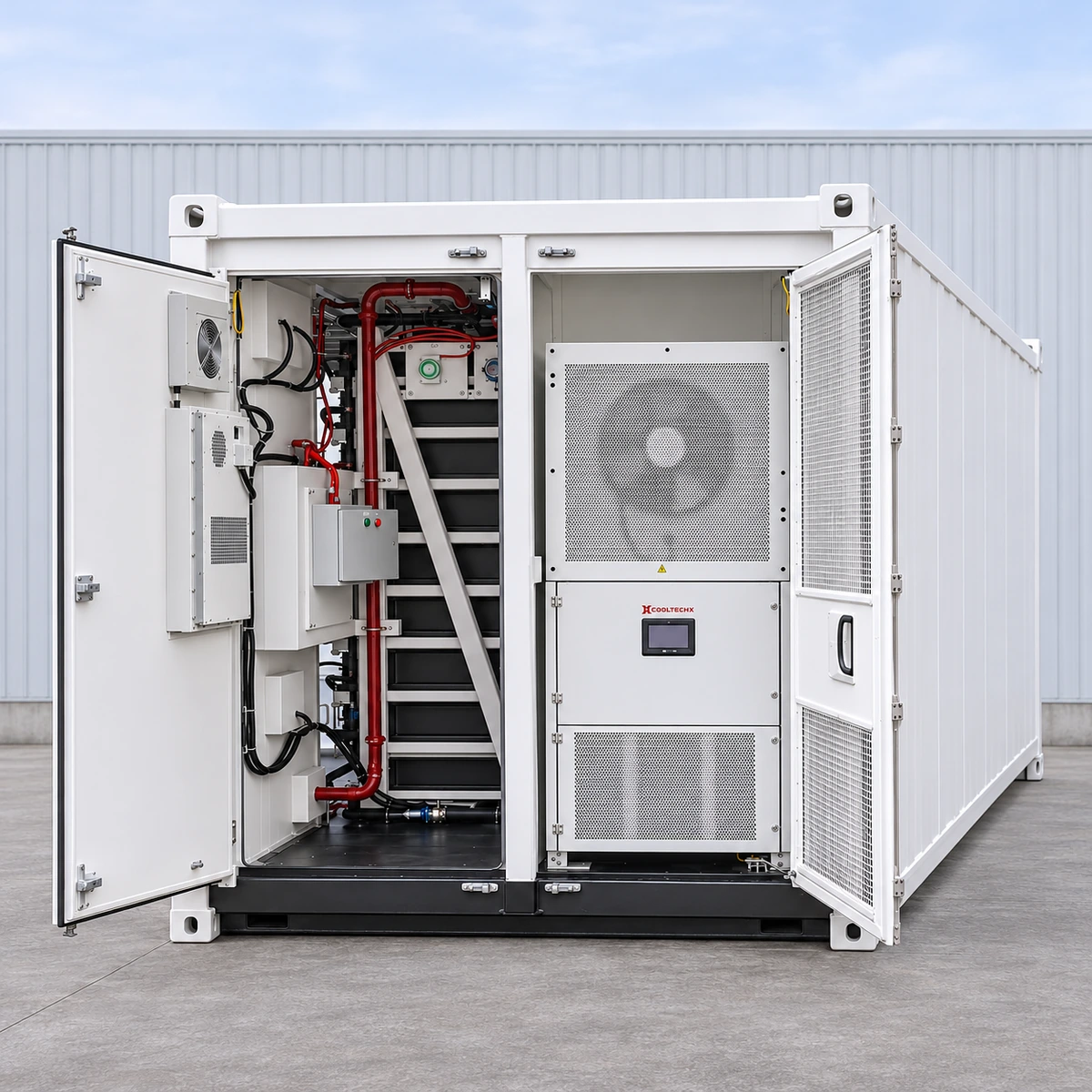
With R32, an A2L refrigerant, the siting question is whether a release from the charged unit could reach a container door, an air intake or a low point where it might collect. The answer depends on geometry, airflow and refrigerant charge, so no universal distance applies, and the review works best from a marked layout showing the unit, doors, intakes and low points. BESS fire setbacks are a separate requirement. Alongside the layout, request the R32 datasheet, nameplate data showing the R32 charge in kg, and safety test reports that name the R32 variant and issuing body.
In the RFQ itself, one paragraph can carry the request: Please quote the R32 configuration of the 80 kW chiller for a BESS project in Spain, with units first placed on the EU market after 1 January 2027. State the net cooling capacity and total electrical input of the R32 configuration at L45/W20 with 50% ethylene glycol and 600 L/min, together with the R32 charge in kg, its GWP under Regulation (EU) 2024/573, and the safety test reports that cover this R32 variant.
Worked example: checking an 80 kW chiller at its rating point
The figures below are the published values for the R410A reference configuration of the Cooltechx 80 kW chiller, at its L45/W20 rating condition with 50% ethylene glycol. They show how to check a rating. R32 performance is confirmed per quotation.
Efficiency. The datasheet states at least 80 kW cooling at no more than 42 kW rated power. 80 ÷ 42 = 1.90 W/W, which matches the published EER of 1.9 or better. Use capacity and input stated at the same condition when you run this check on any supplier. For electrical design, use the maximum input of 47 kW and the maximum starting current of 95 A, not the rated power.
Capacity margin. If a container needs 70 kW of heat removal, the R410A reference rating of 80 kW at L45/W20 leaves 10 kW of margin, about 14% above the load. That figure applies only to the R410A reference configuration at that point, and does not establish what the R32 configuration delivers. A lower coolant supply temperature or a hotter site also changes available capacity, so size against the supplier’s R32 figure at your own duty point.
Hydraulics. Rated flow is 600 L/min with 15 m of head, about 1.6 bar with 50% glycol. Compare that with the container loop’s pressure drop at 600 L/min. External head can be customised if the loop needs more.
Charge and CO₂e. CO₂-equivalent is charge mass multiplied by GWP. For an illustrative 10 kg charge, using the 675 and 2088 values that apply in both the US and the EU, that is 6.75 t CO₂e for R32 and 20.88 t CO₂e for R410A. Take the real charge from the R32 specification rather than assuming it equals the R410A charge.
Cooltechx chillers available in R32
The vertical BESS container liquid cooling units cover 20 to 60 kW across five models, CTS0200L to CTS0600L, rated at L45/W18, with 7 to 24 kW of heating and 150 to 500 L/min of liquid flow depending on model. The 80 kW BESS liquid cooling chiller is rated at L45/W20, with a coolant set range of 10 to 35 °C, ambient operation from −30 to 55 °C and altitude up to 4000 m. Both families are offered in an R32 configuration. Because they are rated at different conditions, compare them at your own duty point. Send that duty point and the destination market through either product page, with a layout showing the container openings and how the unit is mounted where that applies, and we will prepare an R32-configuration specification for your project.