
Quick answer: Select a BESS cooling system from the documented project boundary: the battery arrangement, required heat-removal duty, site conditions, enclosure layout, available utilities, controls and service plan. Air cooling and liquid cooling are different integration approaches; neither can be selected responsibly from a capacity figure alone.
For an EPC, system integrator or battery-system designer, the most useful first step is to collect the project inputs that every potential cooling configuration must satisfy. This makes the request for quotation comparable before the technology decision is final.
Define what the cooling system is responsible for
A battery energy storage system includes equipment supplied by more than one party. Before comparing cooling options, define where the thermal-management scope starts and ends. For example, identify whether the supplier is expected to manage enclosure air, connect to a battery-side liquid loop, provide controls integration, or work within an existing container design.
This avoids a common early-stage problem: two proposals may both use the word “cooling,” but cover different equipment, interfaces and commissioning responsibilities.
Project inputs to collect before evaluating a BESS cooling system
| Project input | What to provide | Why it changes the selection |
|---|---|---|
| Battery and enclosure layout | Rack or module arrangement, container or cabinet drawings, equipment location and service clearances. | Layout affects airflow paths, liquid-loop routing, mounting and maintenance access. |
| Thermal requirement | Expected heat load and the operating or rating condition used to state it. | Capacity figures can be compared only when the conditions behind them are clear. |
| Site environment | Project location, design ambient conditions, solar exposure, dust, humidity, altitude and installation restrictions. | The installation environment affects heat rejection, enclosure design and practical service planning. |
| Utilities and interfaces | Available input power, controls, alarms, communications and—where relevant—pipe or fluid interfaces. | A suitable configuration must fit the project’s electrical and integration requirements. |
| Operation and service model | Access constraints, commissioning responsibilities, maintenance approach and requested documentation. | Serviceability should be considered with the complete container or cabinet arrangement, not after equipment is chosen. |
Separate the technology decision from the RFQ input list
Air cooling and liquid cooling should be compared against the actual battery-system design and project boundary. Air cooling concerns the controlled air path within the enclosure or container. Liquid cooling also requires a defined battery-side thermal loop and documented interfaces between the cooling unit, battery system and installation.
Use our BESS air cooling vs liquid cooling guide to structure the technology discussion. Return to this project-input list when requesting or comparing configurations so the same design assumptions are used throughout the process.
Compare cooling capacity at the stated conditions
A nominal kW figure is not a complete comparison. The project should state the required operating point and ask each supplier to identify the condition used for its quoted capacity. That creates a like-for-like basis before a configuration is shortlisted.
For liquid-loop applications, see what to compare in BESS liquid-cooling capacity ratings. It explains why a rating condition belongs next to every capacity value.
Resolve ownership of the interfaces early
In a multi-party BESS project, battery supplier, container supplier, EPC and thermal-management supplier may each own part of the system. Record who is responsible for the piping or air path, electrical connection, controls and alarms, drawings, installation, filling or commissioning, and later service. Any requirement that is still open should remain an engineering action rather than becoming an unverified assumption in a quotation.
Where project teams are considering one or more liquid circuits, the decision should follow the required integration, operating and maintenance approach. The single vs dual-circuit BESS liquid cooling guide sets out the questions that should be resolved with the system designer.
BESS cooling RFQ checklist
- Battery-system layout and container or cabinet drawings
- Required heat-removal duty and its documented operating condition
- Design site conditions and environmental exposure
- Available input power and electrical requirements
- Controls, monitoring, alarms and communications requirements
- Air path or battery-side fluid-interface requirements, where applicable
- Installation, commissioning, service and documentation responsibilities
- Project-specific specifications, tests or compliance documents
Explore the appropriate cooling path
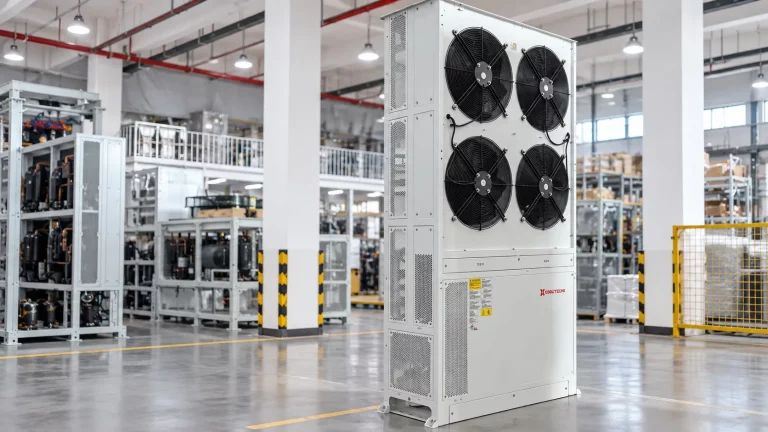
For a project that has chosen an air-based enclosure approach, start with the current energy storage air cooling systems. For a project with a defined battery thermal loop, review the available energy storage liquid cooling systems. In both cases, final selection should be checked against the complete documented project requirement.
Discuss a project requirement
Send the available drawings, operating inputs, site conditions and interface requirements to Cooltechx. A clear project boundary gives the discussion a more useful starting point than a capacity request alone.
Frequently asked questions
What information is needed before selecting a BESS cooling system?
At minimum, provide the battery and enclosure layout, required heat-removal duty with its operating condition, site environment, available power, controls requirements, interfaces and expected service arrangement.
Can a BESS cooling system be selected from kW capacity alone?
No. Capacity must be interpreted with the rating condition and the project’s physical, environmental and interface requirements.
Does every BESS require liquid cooling?
No. The suitable approach depends on the documented battery-system design, heat load, installation boundary and project requirements. Evaluate air and liquid approaches against those inputs rather than a general technology claim.