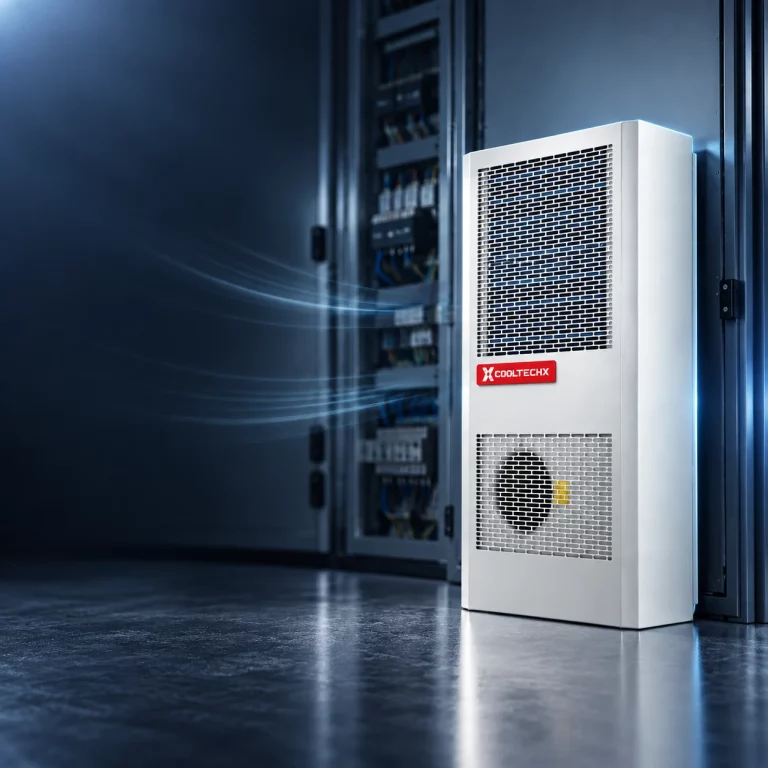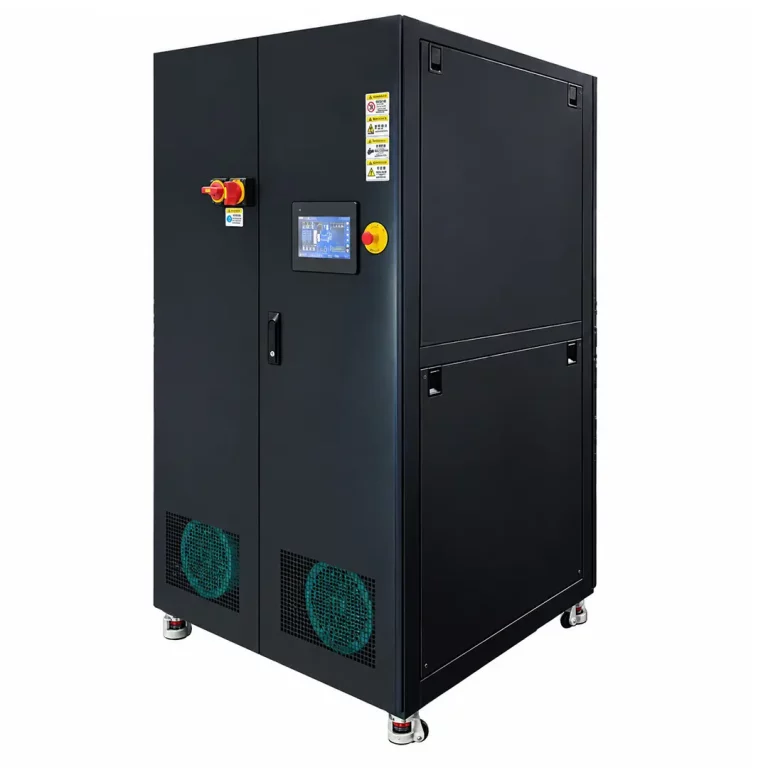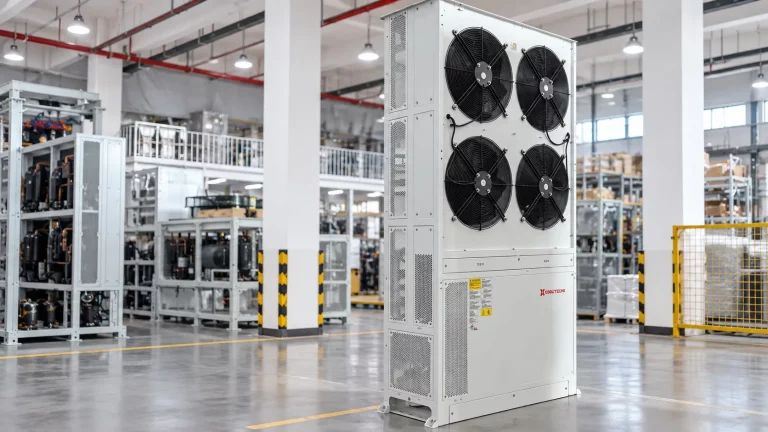

A coolant distribution unit (CDU) is the equipment that transfers heat between a data center’s facility-water loop and the liquid loop serving IT equipment. In a liquid-cooled data center, it is more than a heat exchanger: it provides the flow, pressure control, monitoring and protection needed to operate the secondary coolant loop reliably.
In simple terms, a CDU lets the facility cooling system and the IT cooling system work as two controlled circuits. That separation is important because the two loops can use different fluids, temperatures, pressures and cleanliness requirements.
What does a CDU do in a data center?
A data center CDU has three core jobs:
- Transfer heat between loops. A plate heat exchanger moves heat from the IT-side coolant to the facility-water side without mixing the two fluids.
- Control the IT-side liquid loop. Pumps, valves and controls deliver the required flow and differential pressure to cold plates, rack manifolds or other liquid-cooled loads.
- Protect and monitor the system. A CDU can integrate filtration, pressure stabilization, expansion or refill equipment, leak detection, sensors, alarms and communications for site monitoring.
Where does a CDU sit in the liquid-cooling system?
The basic heat path is:
IT equipment / cold plates → secondary coolant loop → CDU → facility-water loop → heat rejection equipment
The CDU is the boundary between the data center’s IT cooling circuit and the upstream cooling infrastructure. It helps engineers keep secondary-loop flow, pressure and coolant conditions within the operating range required by the IT equipment, while transferring heat to the primary loop.
For the broader room-level precision-cooling boundary and the inputs to define before comparing approaches, see our data center cooling solutions guide.
What are the main components of a liquid-to-liquid CDU?
Exact configurations vary by project, but a liquid-to-liquid CDU commonly combines the following functions in one system:
- Plate heat exchanger: transfers heat between primary and secondary loops.
- Secondary circulation pumps: provide the flow and pressure required by the IT-side network; single- and dual-pump designs serve different availability requirements.
- Pressure stabilization, expansion and refill equipment: help maintain controlled secondary-loop operating conditions.
- Filtration and valves: support fluid cleanliness, isolation and serviceability.
- Sensors and controller: monitor temperatures, pressure, flow and alarms, and can connect to higher-level monitoring through protocols such as Modbus.
These elements must be selected together. A CDU’s kW rating alone does not tell an engineer whether the unit can meet the required flow, head, fluid compatibility, interface or redundancy target.
How do you choose the right CDU capacity and configuration?
Start with the system data rather than a model number. A useful RFQ should define:
- Current IT cooling load and planned expansion load
- Required secondary-loop supply and return temperatures
- Required flow rate and differential-pressure or pressure-control target
- Coolant type and water-quality requirements
- Facility-water temperatures, flow and available pressure
- Piping topology, connection interfaces and available installation space
- Redundancy expectations for pumps, power and controls
For example, a small liquid-cooled deployment may prioritize a compact unit close to the rack, while a multi-row AI or HPC installation may require a higher-capacity, centralized unit with a larger secondary-side network. The correct configuration follows the system boundary and operating requirements—not only the heat load.
Rack-mounted, in-row or room-level CDU?
CDU placement changes how a liquid-cooling system is installed, maintained and expanded:
- Rack-mounted CDU: installed in a standard rack and suited to localized, modular deployments.
- In-row / row-level CDU: installed alongside server cabinets to serve several racks in one row or area.
- Room-level CDU: a centralized system for larger multi-row AI or HPC liquid-cooling networks.
Read the detailed comparison of rack-mounted, in-row and room-level CDU architectures before deciding where the CDU should sit.
Cooltechx liquid-to-liquid CDU series
Cooltechx offers liquid-to-liquid CDU configurations across three deployment levels. Compare the series on the Coolant Distribution Units (CDU) category page, or review the applicable configuration directly:
- Rack-Mounted Liquid-to-Liquid CDU — 35, 80 and 100 kW configurations.
- In-Row / Row-Level Liquid-to-Liquid CDU — 300 and 600 kW configurations for multi-rack deployments.
- Room-Level Liquid-to-Liquid CDU — 900, 1200 and 1800 kW configurations for centralized systems.
Frequently asked questions
Is a CDU the same as a precision air conditioner?
No. A precision air conditioner controls air temperature and humidity in the room or near the IT load. A CDU controls a liquid-cooling boundary and distributes secondary coolant to liquid-cooled equipment.
Can a CDU be selected from its cooling capacity alone?
No. Capacity must be checked with the required temperatures, flow, pressure, coolant, primary-loop conditions, system topology and redundancy target.
What information should I send for a CDU quotation?
Provide the IT heat load, supply and return temperatures, flow and pressure requirements, coolant type, facility-water conditions, piping interfaces, installation location and redundancy requirement. This lets the engineering team evaluate a workable liquid-cooling configuration rather than simply match a nominal kW rating.
Plan your data center liquid-cooling project
If you are defining a new liquid-cooling system or expanding an existing deployment, contact Cooltechx with the operating inputs above. We can help evaluate the appropriate CDU system boundary and configuration for the project.