
AI data center energy storage helps maintain power continuity, control peak demand, smooth rapid load changes and shift renewable electricity to useful hours. A battery energy storage system (BESS) can also provide grid services when its controls, connection agreement and backup reserves allow. The right design matches the duty to discharge power, usable energy, recovery time and thermal limits.
For developers evaluating battery storage for data centers, the central question is which service the battery must deliver—and under what operating conditions. This guide connects BESS applications and deployment choices with practical cooling requirements.
Why AI data center electricity demand matters
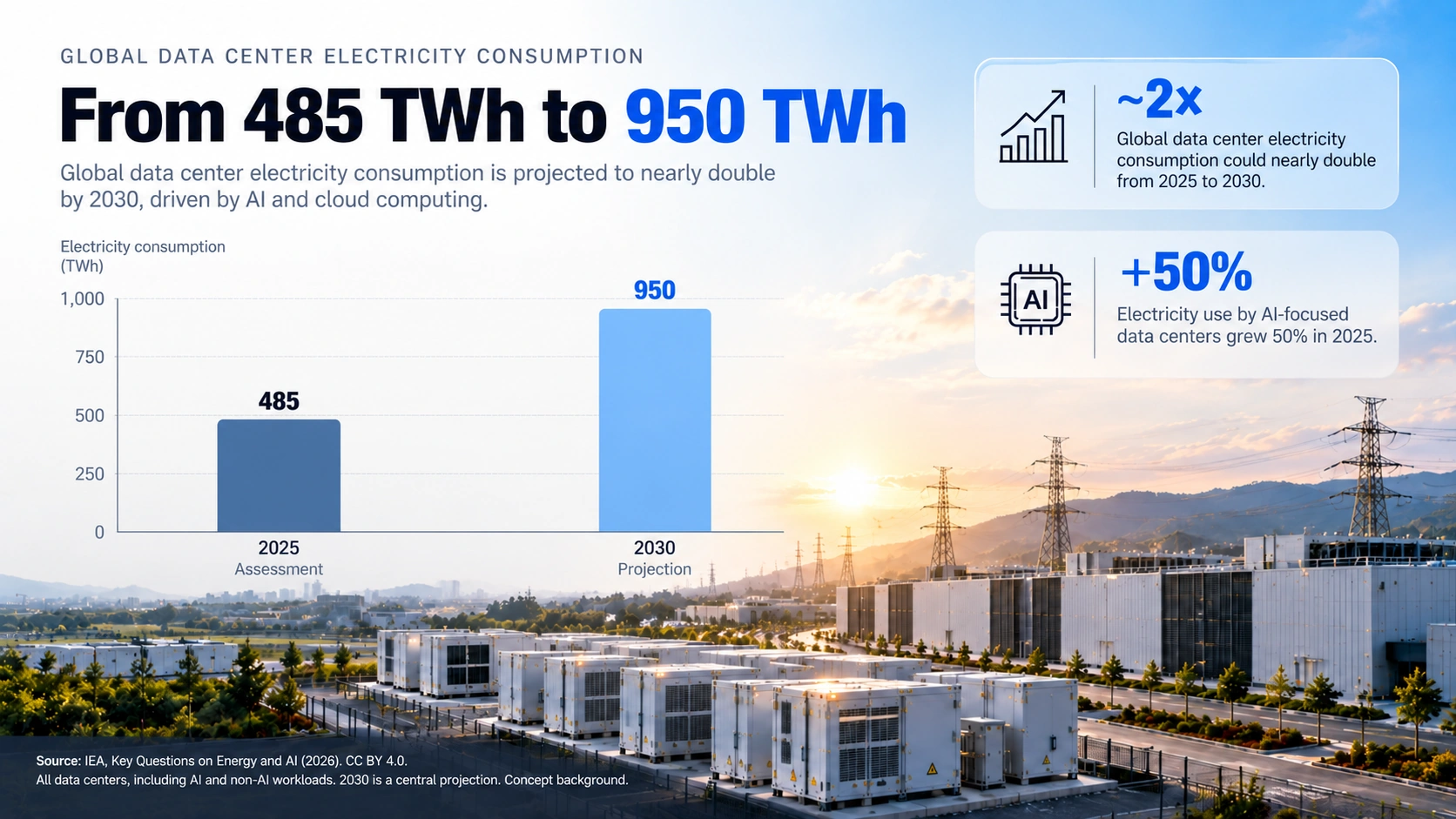
The International Energy Agency’s 2026 Key Questions on Energy and AI assesses global data center electricity consumption at 485 TWh in 2025 and projects 950 TWh in 2030. These figures cover all data centers, including AI and non-AI workloads. [1]
| Year | Electricity use | Status |
|---|---|---|
| 2025 | 485 TWh | Historical-year assessment |
| 2030 | 950 TWh | Central projection |
EPRI’s Powering Intelligence 2026 estimates that data centers represented 4%–5% of US electricity consumption in 2024 and projects a 9%–17% share in 2030. Its US scenarios include cryptocurrency mining; they have a different scope from the IEA’s global figures. [2]
Local infrastructure determines what growth a site can accommodate. Substation capacity, connection timing and import limits matter alongside annual energy use. Storage can manage selected peaks and agreed flexibility, provided the connection also has sufficient charging headroom.
Five BESS applications for data centers
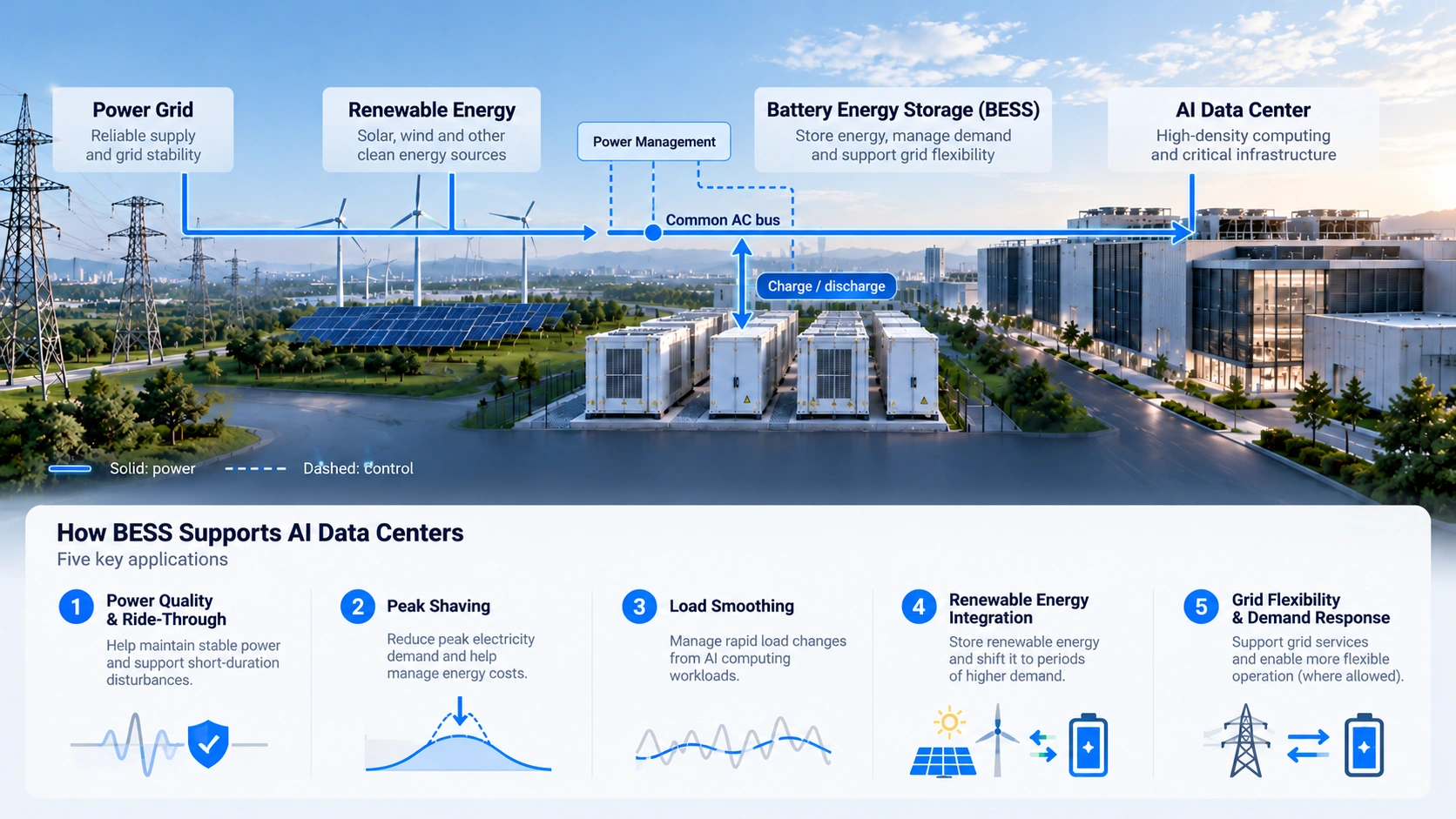
| Application | Indicative operating window | Sizing focus | Reserve requirement |
|---|---|---|---|
| Continuity support | Seconds to minutes for ride-through; longer backup is site-specific | Response, power and critical-load energy | Protect the required continuity reserve |
| Peak shaving | Demand-charge interval to hours | Power above the import target and event energy | Ring-fence any shared backup reserve |
| Renewable shifting | Hours; multi-day duties need a separate design | Usable energy, charging opportunity and losses | Retain critical-load reserve if shared |
| Load smoothing | Rapid changes to repeated ramps | Response, power and cycling duty | Maintain charge and discharge headroom |
| Grid services | Response time and duration defined by the program | Qualified response and committed capacity | Deduct protected backup energy |
These windows are engineering descriptions, not product ratings. The applicable tariff, reliability case and service specification determine the final requirements.
Continuity and backup support
Batteries can support ride-through and provide energy while other resources start or a controlled shutdown occurs. Continuity performance depends on its integration with the UPS and critical-load path. Transfer arrangements, protection, fault response and the critical load path determine whether servers experience an interruption. Backup duration must include the loads required to keep the supported IT equipment operating safely, including essential cooling and controls.
Peak shaving for data center demand
A BESS can discharge during high site demand to reduce the power imported at the meter. This may reduce demand charges or help a facility operate within an agreed import limit. Savings depend on the tariff, dispatch window and battery cycling cost. Recharging must be scheduled carefully: a depleted battery can create a new peak if its charging load overlaps with high computing demand.
Renewable energy shifting
Storage can absorb electricity during periods of renewable availability and release it later. This helps address the timing gap between generation and consumption. Round-the-clock carbon-free operation requires generation coverage, temporal matching and sufficient stored energy through low-output periods, including charging losses. DOE describes storage as a way to make solar energy available beyond its production hours. [9]
Load smoothing and ramp management
AI workloads can change electrical demand quickly. Properly designed storage and power electronics can buffer selected changes at the site connection. The response depends on measurement, control latency, inverter capability and available state of charge. Very fast disturbances may require equipment closer to the IT load; a bulk battery connected upstream should not be assumed to solve every rack-level power-quality issue.
Demand response and grid services
Subject to market access and technical qualification, batteries can support demand response, frequency services or other grid programs. EPRI’s DCFlex initiative is examining how data center flexibility can support network operation and connections. [3] Operators should reserve the energy needed for continuity before selling flexibility. Revenue estimates must reflect that the same available capacity cannot simultaneously satisfy conflicting service commitments.
Three architectures for AI data center energy storage
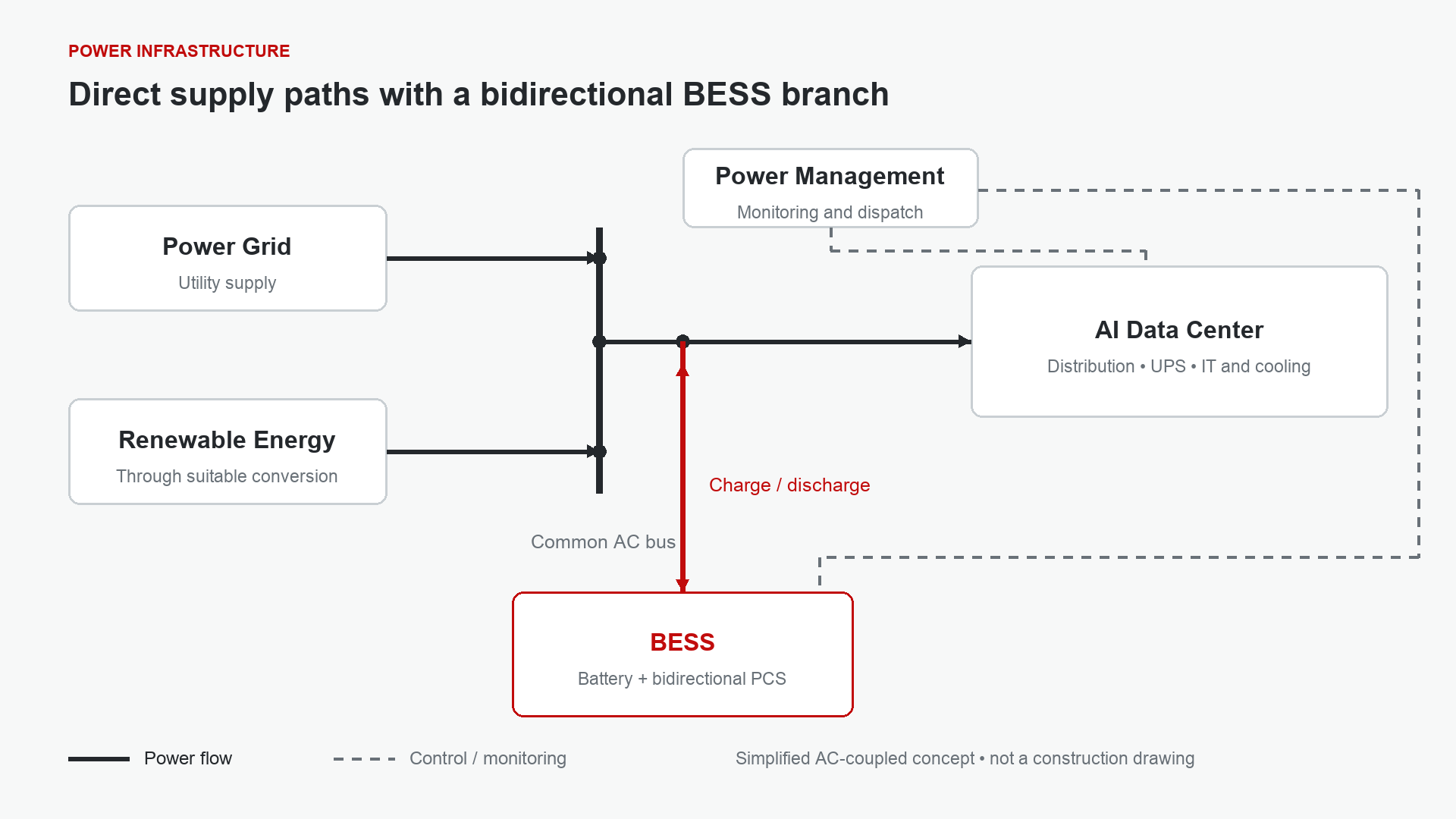
A BESS is a controllable, bidirectional branch of the power system. Grid and renewable electricity can feed a common bus and supply the data center directly. Power management coordinates charging, discharging and operating reserves.
| Architecture | Connection and role | Local backup capability |
|---|---|---|
| Behind the meter | On the customer side; manages site imports and local resources | Possible with the required critical-load path, switching and controls |
| Grid-side or offsite | On the regional network; supports energy supply and grid capacity | Requires a separate onsite solution for a failed campus connection |
| Integrated microgrid | Coordinates storage, renewables, utility and specified generation | Depends on islanding, protection and resource adequacy design |
Behind-the-meter campus BESS
An onsite system connects within the customer’s electrical boundary. It can manage imported power, support local renewable generation and potentially serve designated critical loads. Islanded operation requires suitable switching, protection and voltage and frequency control. Engineers must establish which loads remain energized and how the system reconnects to the utility after an outage.
Grid-side or offsite storage
A utility or developer can build storage on the network serving a data center region. Benefits may reach the customer through a utility service arrangement or energy contract. This architecture can support regional adequacy and renewable integration, but it does not automatically provide local backup behind a failed customer connection. Contractual energy procurement and physical resilience are separate design questions.
Integrated microgrid and hybrid supply
A microgrid can coordinate batteries, renewable generation, the utility and, where specified, dispatchable generation. Its controller allocates resources against operating limits and reserve priorities. A DC-coupled design may share conversion equipment with solar, while an AC-coupled system connects resources through an AC bus. Both can preserve a direct supply route to the load. Selection depends on site interfaces, losses, maintainability and the required islanding strategy.
UPS vs BESS for data centers
A UPS protects the critical electrical load during disturbances and supply transitions. A BESS adds energy storage that can support a wider set of site and grid duties. Their functions can overlap when engineered together, but response and continuity must be verified across the complete power path.
| Design question | UPS | BESS |
|---|---|---|
| Primary role | Continuity and power conditioning for critical loads | Stored energy for site operation, flexibility and defined backup duties |
| Typical design boundary | Critical-load distribution path | Campus, microgrid or grid connection |
| Duration | Specified ride-through and autonomy | Specified discharge duty and usable energy |
| Coordination | Transfers and downstream load protection | Dispatch, state of charge, reserve and recharge strategy |
Real projects linking data centers and battery storage
Pine Island: Google’s 30 GWh iron-air storage example
In February 2026, Google and Xcel Energy announced an arrangement for a future Pine Island, Minnesota data center that includes 1,400 MW of wind, 200 MW of solar and 300 MW of Form Energy iron-air storage. Xcel specified 30 GWh of storage with a 100-hour discharge design. These are announced project specifications, rather than commissioned capacity. [4][5]
Pine Island illustrates multi-day balancing at grid scale. The 300 MW power rating and 30 GWh energy capacity describe different capabilities; campus backup duration would depend on the supported load and its electrical connection.
Steel River: solar and BESS for regional grid supply
Google and Cypress Creek Energy broke ground on Steel River Energy Center in Arkansas in July 2026. Google describes phases one and two as 1.6 GWdc of solar and 1.9 GWh of storage, with the full project planned at 2.5 GWdc and 2.9 GWh for operation in 2029. The developer lists the fuller-precision scope as 2.46 GW solar and 2.94 GWh storage. [6][7]
This construction-stage project illustrates grid-side renewable shifting: batteries store solar output for later delivery to the regional network. The solar power rating and battery energy capacity alone do not establish discharge duration.
Belgium: an operating battery backup reference
Google’s December 2022 clean-energy update reported that its Belgium battery backup system had been installed and was being used, with the ability to provide grid services. This operating reference demonstrates how continuity and grid participation can be combined; the newer US announcements represent different development stages. [8]
How to size BESS around the operating duty
Start with a load profile and a service requirement. Required discharge power is measured in MW; delivered energy over the required interval is measured in MWh. A flat 10 MW load supported for two hours requires 20 MWh delivered to that load before allowances for conversion losses, battery operating limits, auxiliary consumption and future degradation. This is an illustrative calculation, not a product recommendation.
Specify beginning-of-life and end-of-life usable energy, operating temperature, reserve state of charge and recovery time after an event. Model several duties together: peak reduction today must not leave insufficient reserve for an outage tonight. Include charging headroom and the time needed to restore readiness after successive dispatches.
The electrical study should address harmonics, fault contribution, protection coordination, export limits and behavior during utility disturbances. Grid-forming capability, islanding and black start are distinct functions requiring explicit equipment and system design. Commissioning should verify transitions and failure responses, including loss of communications or cooling, rather than relying only on normal-operation demonstrations.
Commercial evaluation should include energy losses, auxiliary electricity, maintenance, degradation, potential augmentation and service restrictions. Storage may defer selected infrastructure investments where a utility accepts a flexible arrangement. It cannot indefinitely supply an energy deficit without enough charging energy or another source of generation.
BESS Thermal Management: Why Liquid Cooling Matters for AI Data Center Storage
Frequent cycling and high-power operation generate heat that the battery system must reject within its operating limits. Temperature uniformity also matters: cooling should support the intended charge and discharge duty across the pack. The useful comparison is how each cooling architecture performs at the required heat load, ambient conditions and service arrangement.
Liquid cooling vs air cooling for BESS
| Selection factor | Air cooling | Liquid cooling |
|---|---|---|
| Heat-transfer path | Airflow carries heat from battery surfaces | Cold plates or equivalent interfaces transfer heat to a coolant loop |
| High heat density | Assess airflow paths, pressure loss and fan demand | Can bring heat removal closer to cells; validate cold-plate contact and flow distribution |
| Temperature distribution | Depends on enclosure airflow and rack layout | Depends on hydraulic balance, interface design and coolant temperature |
| Maintenance and auxiliaries | Fans, filters, air paths and enclosure conditions | Pumps, coolant quality, leak detection, filtration and heat rejection |
Liquid cooling can be a practical choice for dense, high-duty storage. Final selection should compare thermal performance, auxiliary consumption, maintenance and installed cost. For a fuller comparison, see BESS air cooling vs liquid cooling.
Estimate heat load before selecting cooling capacity
Start with battery-supplier heat-generation data over the intended charge and discharge profile. Add the heat loads inside the cooling system’s supply boundary, then evaluate the hottest design ambient, coolant target and available heat rejection. Whole-system electrical losses also include equipment outside the battery loop, so the battery’s thermal duty should be identified separately.
For a measured liquid loop, heat carried by the coolant can be checked from Q ≈ ṁ × cₚ × (Treturn − Tsupply), using the actual coolant properties. Check both peak duty and sustained operation, plus the required redundancy and recovery margin. Battery MWh specifies stored energy; it does not determine cooling kW. See the BESS cooling capacity and rating-condition guide.
A 60 kW container BESS chiller reference
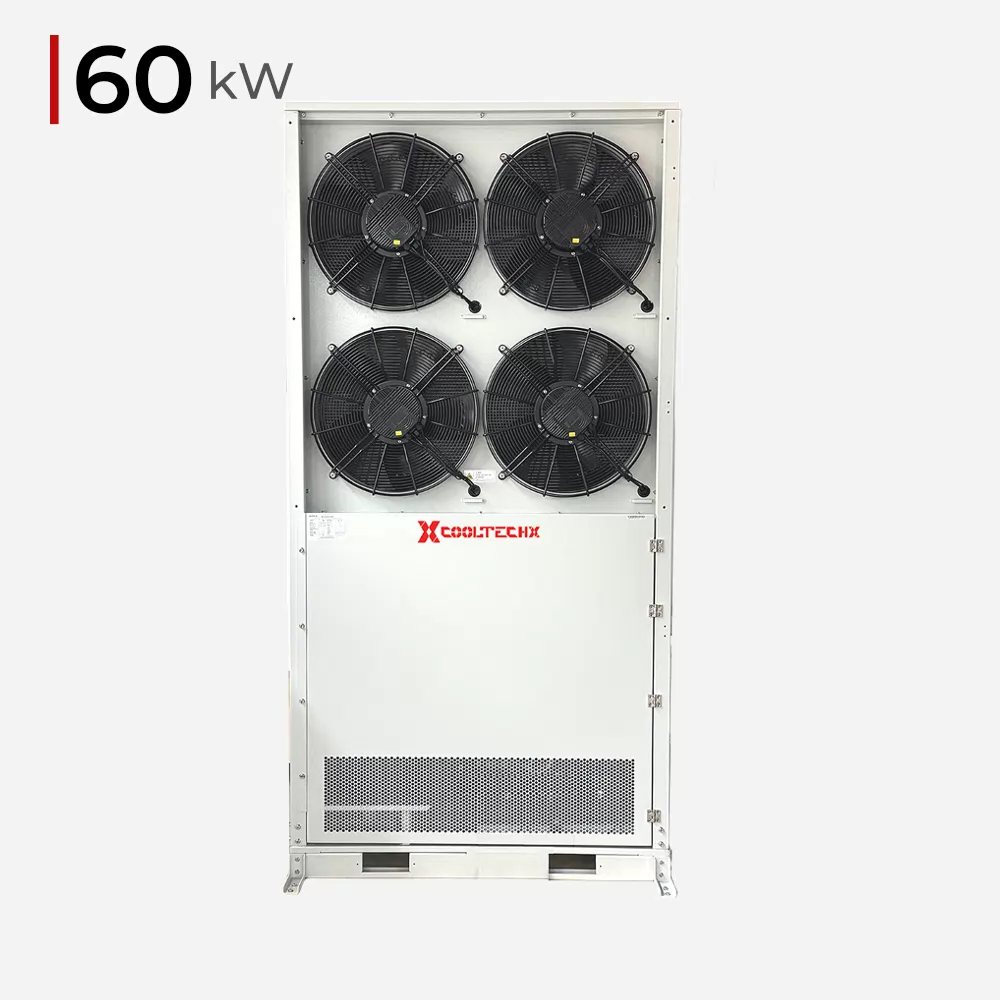
Cooltechx’s CTS0600L 60 kW liquid cooling chiller for container BESS provides an equipment-level reference. The following values come from its published reference configuration. [11]
| Parameter | Published reference value |
|---|---|
| Cooling capacity | 60 kW at L45/W18 |
| Liquid supply temperature | 18 °C reference point; not a published adjustable range |
| Liquid flow rate | 500 L/min |
| External resistance | 150 kPa |
| Cooling input power | 35 kW at L45/W18 |
| Rated electrical supply | 380 V ±10% / 50 Hz ±1 Hz |
| Operating ambient | −30 °C to +55 °C; verify capacity at the required duty point |
| Coolant ports and connections | Confirm from the approved installation drawing; port size is not stated on the product page |
The product page lists an R410A reference configuration and an available R32 configuration. Request matching performance data for the selected configuration. L45/W18 is a stated rating condition, not a performance guarantee across the ambient range. A nominal 60 kW unit is therefore a starting reference, rather than a fixed match for every battery container.
Explore BESS liquid cooling units and battery chillers and the 60 kW containerized BESS application reference. Data center coolant distribution units address server-loop interfaces—a separate thermal scope from the battery chiller. [12]
Prepare the cooling equipment selection inputs
- Battery heat-load profile, charge/discharge duty and permitted temperatures.
- Coolant type, supply/return targets, flow and pressure-loss allowance.
- Site ambient range, installation layout, service access and heat rejection.
- Electrical supply, controls, alarms, redundancy and connection drawings.
Include leak detection, coolant compatibility, freeze protection and condensation control in the integration review. Enclosure humidity control is a separate requirement from battery coolant temperature control. Normal cooling complements the safety design; DOE cautions against making thermal-runaway propagation prevention depend on coolant circulation. [10]
AI data center energy storage FAQs
Does every AI data center need a separate BESS?
No. The appropriate design depends on utility reliability, existing UPS and generation, tariffs, renewable procurement and flexibility obligations. The relevant question is which requirement storage can meet more effectively than the available alternatives.
Can a BESS replace diesel generators?
It can replace or reduce selected generator duties when usable energy, load coverage and recovery arrangements satisfy the required reliability case. Extended outages and consecutive events require explicit analysis. A grid-side storage contract alone does not supply an isolated campus.
Is a two-hour or four-hour battery enough?
Duration follows the service. A short peak window, an extended outage and a multi-day renewable shortfall are different problems. Define the supported power and event length before specifying energy capacity, reserve and recharge requirements.
Does BESS guarantee lower carbon emissions?
No. Results depend on charging electricity, dispatch timing, losses and the generation displaced. Annual renewable matching also differs from hourly carbon-free supply. Evaluate the actual operating and accounting boundaries before making an emissions claim.
How should cooling equipment be selected?
Use the battery supplier’s heat-generation data and coolant limits, combined with site conditions and redundancy requirements. Confirm performance at the required operating point and include cooling auxiliaries in the site energy model. This connects battery thermal design to dependable power delivery.
Further reading on BESS cooling
- BESS air cooling vs liquid cooling
- How to compare BESS chiller capacity and rating conditions
- BESS cooling system selection: project inputs
References
Sources checked on 23 October 2026. Forecasts, announced projects and operational references are identified separately in the text. Project schedules remain subject to change.
[1] IEA — Key Questions on Energy and AI, executive summary, 2026. Global data center electricity assessment and central outlook; CC BY 4.0.
[2] EPRI — Powering Intelligence 2026, executive summary. US scenario range and scope.
[3] EPRI — DCFlex. Data center flexibility initiative.
[4] Google — Google is coming to Minnesota and advancing clean energy goals, 24 February 2026.
[5] Xcel Energy — Xcel Energy to power new Google data center in Minnesota, 24 February 2026.
[6] Google — Our largest solar and battery storage project ever, 14 July 2026.
[7] Cypress Creek Energy — Steel River Energy Center. Project scope and expected phased completion.
[8] Google — An update on our clean energy progress in 2022, 21 December 2022.
[9] US Department of Energy — Solar Integration: Solar Energy and Storage Basics.
[10] US Department of Energy — Energy Storage Safety Strategic Plan, May 2024.
[11] Cooltechx — 60 kW Liquid Cooling Chiller for Container BESS. Official product image and equipment reference.
[12] Cooltechx — Coolant Distribution Units. Data center cooling scope.