

As AI, high-performance computing (HPC), and GPU clusters continue to increase data center power density, liquid cooling is becoming an increasingly important part of modern thermal management design. Advanced AI clusters can exceed 100 kW per rack, creating cooling demands that are difficult to address with traditional air cooling alone.
At the center of many direct-to-chip liquid cooling systems is the Coolant Distribution Unit (CDU).
But choosing a CDU is not simply a matter of selecting a cooling capacity in kilowatts.
One of the most important decisions is where the CDU should be deployed:
- Rack-mounted CDU
- In-row CDU
- Room-level or floor-mounted CDU
Each architecture has different implications for piping, rack space, cooling capacity, redundancy, maintenance, and future expansion.
So which CDU architecture is right for your data center?
What Does a CDU Do in a Liquid Cooling System?
The Open Compute Project defines a liquid-to-liquid CDU as the heat exchange equipment that separates the technology cooling system from the facility water system while controlling coolant flow, pressure, and temperature.
In a typical direct-to-chip cooling system, the CDU connects two separate cooling loops:
Facility Water System (FWS)
↓
CDU Heat Exchanger
↓
Technology Cooling System (TCS)
↓
Manifold → Server Cold Plates → CPU/GPU
The facility-side fluid and IT-side coolant remain hydraulically separated through the CDU heat exchanger. The secondary loop then supplies controlled coolant to the servers.
This makes the CDU much more than a heat exchanger. Pumps, sensors, filters, valves and control systems also enable the CDU to manage flow, pressure, temperature and system status.
For a practical explanation of the CDU boundary, functions and key components, read What Is a CDU in a Data Center?
As liquid cooling systems scale, however, the physical location and capacity of the CDU become increasingly important.
1. Rack-Mounted CDU: Cooling Close to the IT Load
A rack-mounted CDU, also called an in-rack CDU, is installed directly inside the server rack.
OCP describes an in-rack CDU as a standard rack-mount chassis—such as a 4U or 5U unit—connected directly to the rack manifold and supplying coolant to the IT equipment within that rack.
When Does a Rack-Mounted CDU Make Sense?
Rack-mounted CDUs are particularly attractive when:
- Cooling is required for an individual high-density rack
- The deployment is relatively modular
- Liquid cooling capacity will be added gradually
- Short secondary-side piping runs are preferred
- Independent control at rack level is important
Because the CDU is close to the server manifold, the secondary coolant distribution path can remain relatively short.
Schneider Electric notes that in-rack CDUs bring cooling directly to an individual high-density rack and can help operators scale infrastructure incrementally as demand grows.
The Trade-Off: Rack Space
The main disadvantage is straightforward:
The CDU occupies valuable rack U-space.
That is space that can no longer be used for GPUs, CPUs, networking equipment or other IT hardware.
Rack-level deployment can also mean more individual CDU units to monitor and maintain when the number of liquid-cooled racks increases.
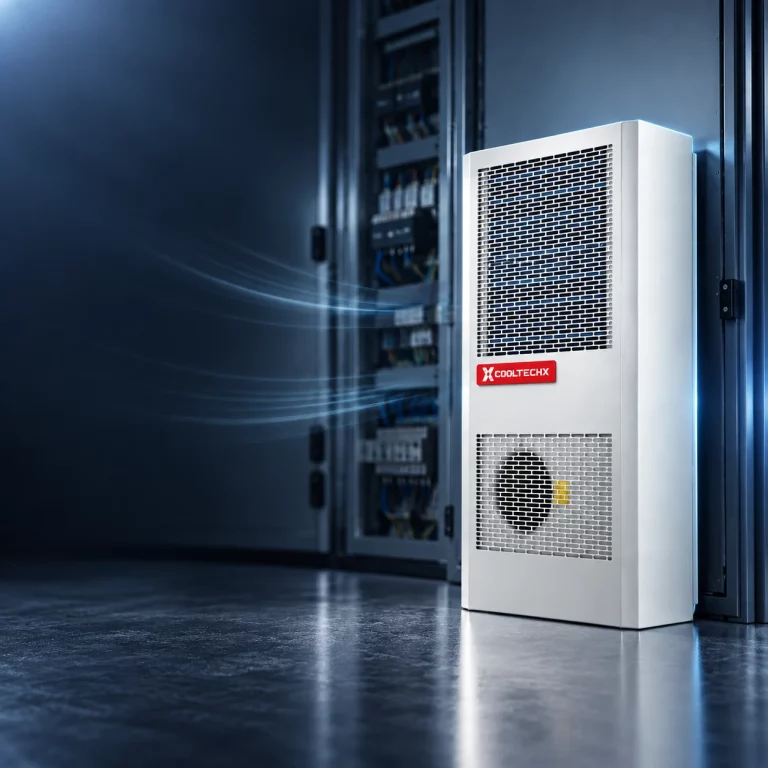
Cooltechx Rack-Mounted Liquid-to-Liquid CDU
Cooltechx’s rack-mounted liquid-to-liquid CDU uses a standard 4U rack architecture and is designed for high-power-density data center racks. The system integrates stainless-steel piping, centrifugal pumps, active anti-condensation control, leak detection, automatic refill and comprehensive monitoring. Constant differential-pressure and constant-flow control modes are available, together with Modbus RTU and TCP/IP communication.
Redundant pump architecture and dual power supply capability can also be incorporated for applications where cooling continuity is critical.
For project parameters and available models, see the Rack-Mounted Liquid-to-Liquid CDU series (35, 80 and 100 kW).
Typical positioning:
One rack / modular deployment → Rack-Mounted CDU
2. In-Row CDU: A Balance Between Local and Centralized Cooling
As the number of liquid-cooled racks increases, installing one CDU inside every rack may no longer be the most practical architecture.
This is where the in-row CDU becomes attractive.
OCP describes an in-row CDU as a larger-capacity unit installed next to or near an array of liquid-cooled racks. Instead of serving only one rack, the CDU connects to the technology cooling network and can support multiple racks.
The architecture may look like:
In-Row CDU
↓
Row Manifold / Distribution Piping
├─ Rack 1
├─ Rack 2
├─ Rack 3
└─ Rack 4
OCP’s liquid cooling integration guidance also identifies row-based CDUs as one of the primary methods for distributing fluid to groups of liquid-cooled racks.
Why Choose an In-Row CDU?
An in-row CDU can offer a useful middle ground between distributed rack-level cooling and large centralized cooling plants.
It is particularly suitable when:
- Several neighboring racks require liquid cooling
- Cooling infrastructure should remain close to the IT equipment
- Operators want to reduce the number of individual CDUs
- The data center is expanding row by row
- Centralized monitoring and maintenance are preferred
Because one CDU can serve multiple racks, cooling infrastructure can be consolidated without moving the CDU far away from the IT load.
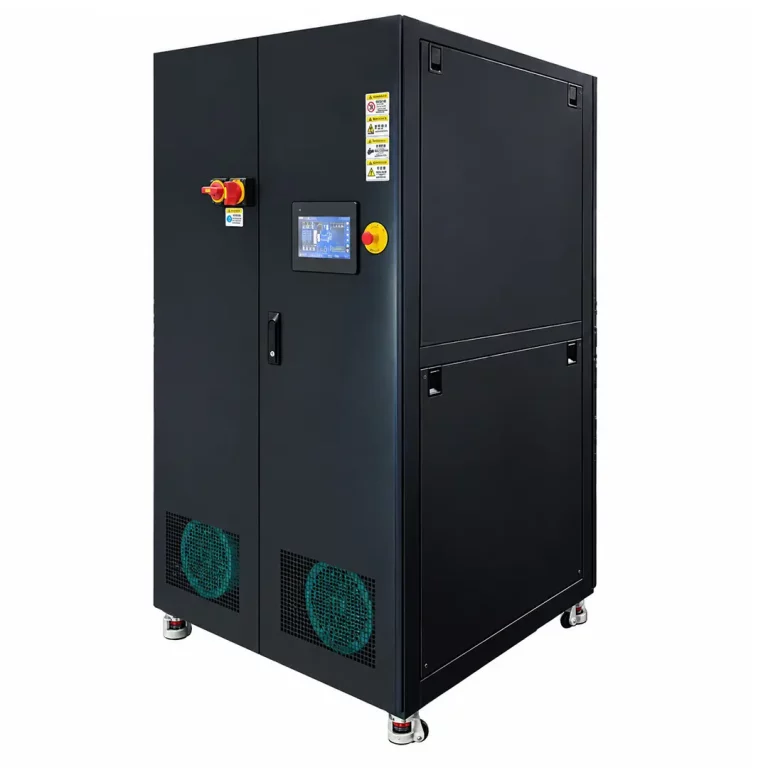
Cooltechx In-Row CDU
Cooltechx’s in-row CDU is designed to be installed alongside server cabinets and combines a plate heat exchanger, secondary circulation pumps, pressure stabilization and refill equipment, filtration, valves, sensors and intelligent control.
Available functions include dual-power backup, single or dual variable-speed pump configurations, anti-condensation control, optional high-precision filtration, automatic refill, intelligent group control, water-quality monitoring, leak detection and adjustable coolant flow.
This architecture is especially useful when a project has moved beyond a single liquid-cooled rack but does not yet require a fully centralized room-level cooling system.
For project parameters and available models, see the Row-Level Liquid-to-Liquid CDU series (300 and 600 kW).
Typical positioning:
Several racks / row-based deployment → In-Row CDU
3. Room-Level CDU: Centralized Cooling for Large Liquid Cooling Systems
When liquid cooling expands from individual racks to large AI or HPC clusters, cooling infrastructure often needs to become more centralized.
This leads to the room-level CDU, also commonly described in the industry as a floor-mounted CDU, perimeter CDU or centralized CDU depending on its installation location.
Schneider Electric notes that floor-mounted CDUs can support groups of high-density racks and centralize cooling and service. These units may be installed within the white space, at the end of a row, or in a separate mechanical room when operators want to preserve valuable data hall floor space or separate mechanical and IT equipment.
Vertiv similarly offers CDU architectures covering in-rack, in-row and perimeter-based installations, illustrating how CDU placement changes as system scale increases.
When Does Room-Level Cooling Make Sense?
Room-level CDU architecture is particularly relevant for:
- Large AI training clusters
- HPC environments
- Large groups of liquid-cooled racks
- Centralized secondary cooling networks
- Large ring-piping systems
- Projects requiring higher flow and pump head
- Data centers designed for future large-scale expansion
Instead of deploying a CDU next to every rack or row, centralized CDUs supply coolant through a larger distribution network.
The architecture may look like:
Facility Cooling System
↓
Room-Level CDU
↓
Main Supply / Return Network
├─ Row A → Multiple racks
├─ Row B → Multiple racks
├─ Row C → Multiple racks
└─ Row D → Multiple racks
This architecture can simplify centralized maintenance and redundancy planning, although it also requires more careful hydraulic design, piping layout and system commissioning.
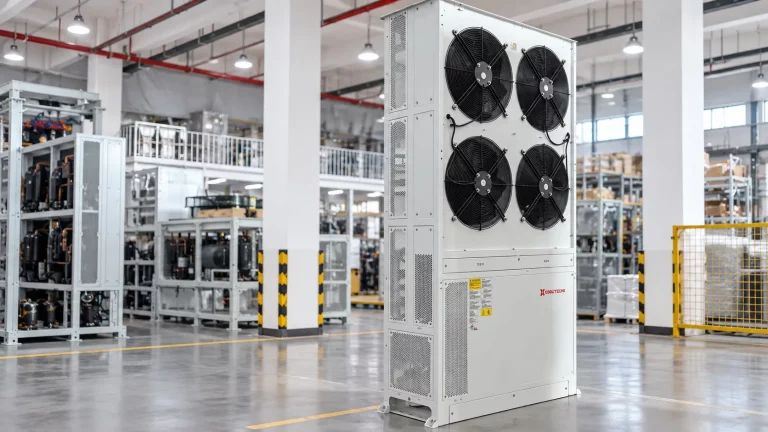
Cooltechx Room-Level CDU
Cooltechx’s room-level CDU is designed as a large centralized cooling unit installed independently in a mechanical or cooling room. It integrates plate heat exchangers, circulation pumps, pressure stabilization, expansion equipment, filtration, valves, sensors and control systems.
The design supports high-flow and high-head operation for large secondary-side ring networks, together with multiple operating modes including differential-pressure control, flow control, cold standby, hot standby, standalone operation, group control, local control and remote control.
RS485 and RJ45 connectivity and protocols including Modbus are available for integration with higher-level monitoring systems.
For project parameters and available models, see the Room-Level Liquid-to-Liquid CDU series (900, 1200 and 1800 kW).
Typical positioning:
Large AI/HPC cluster / centralized cooling → Room-Level CDU
Rack-Mounted vs In-Row vs Room-Level CDU: Quick Comparison
| Factor | Rack-Mounted CDU | In-Row CDU | Room-Level CDU |
|---|---|---|---|
| Installation | Inside server rack | Beside server racks | Data hall perimeter or mechanical room |
| Typical scope | Individual rack | Multiple racks in a row | Multiple rows / large system |
| Cooling architecture | Distributed | Semi-centralized | Centralized |
| Secondary piping distance | Short | Medium | Longer |
| Rack space impact | Uses rack U-space | No rack U-space required | No rack U-space required |
| Expansion | Highly modular | Row-by-row | System-level |
| Maintenance | Per rack | Centralized by row | Centralized |
| Best suited for | Modular high-density racks | Medium-scale deployments | Large AI/HPC clusters |
There is no universally “best” CDU architecture.
The correct choice depends on how the entire liquid cooling system is designed.
Six Questions to Ask Before Selecting a CDU Architecture
1. How Many Racks Need Liquid Cooling?
This is usually the first decision point.
One isolated rack may justify a rack-mounted CDU.
Several adjacent racks may make an in-row CDU more practical.
A large cluster spanning multiple rows may favor room-level centralized cooling.
Schneider Electric makes a similar distinction: in-rack CDUs are generally appropriate for standalone high-density racks, while floor-mounted systems become more practical as multiple racks share cooling infrastructure.
2. How Much Cooling Capacity Is Required Today — and in Three Years?
Do not size the architecture only for the current IT load.
AI infrastructure can expand quickly.
A system designed for four racks today may need to support significantly more capacity later.
Scalability should therefore be evaluated at both the CDU level and the distribution-network level.
3. How Much White-Space and Rack Space Is Available?
Rack-mounted CDUs minimize external floor equipment but consume server rack space.
In-row CDUs consume data-hall floor space but preserve rack U-space.
Room-level CDUs may be moved into a dedicated mechanical room, helping keep mechanical infrastructure separate from the IT white space.
The right answer depends on which resource is more valuable in your facility.
4. What Are the Flow and Pressure Requirements?
Cooling capacity in kW is only part of CDU selection.
The CDU must also deliver the required coolant flow across:
CDU → main piping → manifold → hoses → cold plates → return network
Pressure losses accumulate across every component.
OCP specifically identifies flow, pressure and temperature control as fundamental CDU functions.
For larger centralized systems, pump head and hydraulic network design become increasingly important.
5. What Redundancy Level Does the Data Center Require?
Cooling is mission-critical infrastructure.
Potential design questions include:
- Single pump or redundant pumps?
- Cold standby or hot standby?
- Dual power input?
- N+1 CDU architecture?
- Can pumps, filters or other components be serviced without shutting down cooling?
- What happens if one CDU goes offline?
The answers can have a major influence on whether cooling should be distributed across racks or centralized across multiple CDUs.
6. How Will the CDU Integrate With Data Center Monitoring?
Modern CDUs should not operate as isolated mechanical devices.
Operators increasingly require visibility into:
- Supply and return temperature
- Flow rate
- Differential pressure
- Pump status
- Coolant level
- Leak detection
- Water quality
- Alarm status
OCP describes the CDU as an intelligent component equipped with sensors and controls that regulates both sides of the cooling system and communicates operating status to data center operators.
Monitoring and communication architecture should therefore be considered during CDU selection—not after installation.
The Future of CDU Architecture Is Scalable
The transition to liquid cooling is closely linked to the continuing increase in AI computing density.
NVIDIA’s current Vera Rubin architecture, for example, continues the move toward single-phase direct liquid cooling for rack-scale AI infrastructure.
At the same time, OCP continues to develop CDU guidance, reference designs, testing methodology and integration standards for both new and existing data centers.
This means future liquid cooling systems cannot be designed around cooling capacity alone.
They must be designed around:
capacity + flow + pressure + redundancy + deployment architecture + scalability
And that is why CDU placement matters.
For a broader overview of room-level, in-row and liquid-cooling system boundaries, together with the project inputs to define before comparing approaches, see our data center cooling solutions guide.
Which CDU Architecture Should You Choose?
A simple starting point is:
Individual rack → Rack-Mounted CDU
Multiple racks in one area → In-Row CDU
Large multi-row AI/HPC deployment → Room-Level CDU
But final CDU selection should always be based on actual project conditions, including heat load, coolant temperatures, flow rate, pressure requirements, piping topology, facility water conditions and redundancy strategy.
Cooltechx provides liquid cooling solutions covering rack-mounted liquid-to-liquid CDU, in-row CDU and room-level centralized CDU architectures, allowing cooling infrastructure to scale with different data center deployment requirements.
Browse the Coolant Distribution Units (CDU) category to compare all three deployment levels.
Planning a Liquid Cooling Project?
Choosing the right CDU architecture starts with understanding the complete cooling loop—not simply selecting a kW rating.
Send Cooltechx your:
- IT cooling load
- Number of racks
- Required supply and return temperatures
- Coolant type
- Flow requirement
- Pressure / differential-pressure requirement
- Facility water conditions
- Redundancy requirements
Our engineering team can help evaluate the appropriate CDU architecture and liquid cooling configuration for your project.
Contact Cooltechx to discuss your data center liquid cooling requirements.