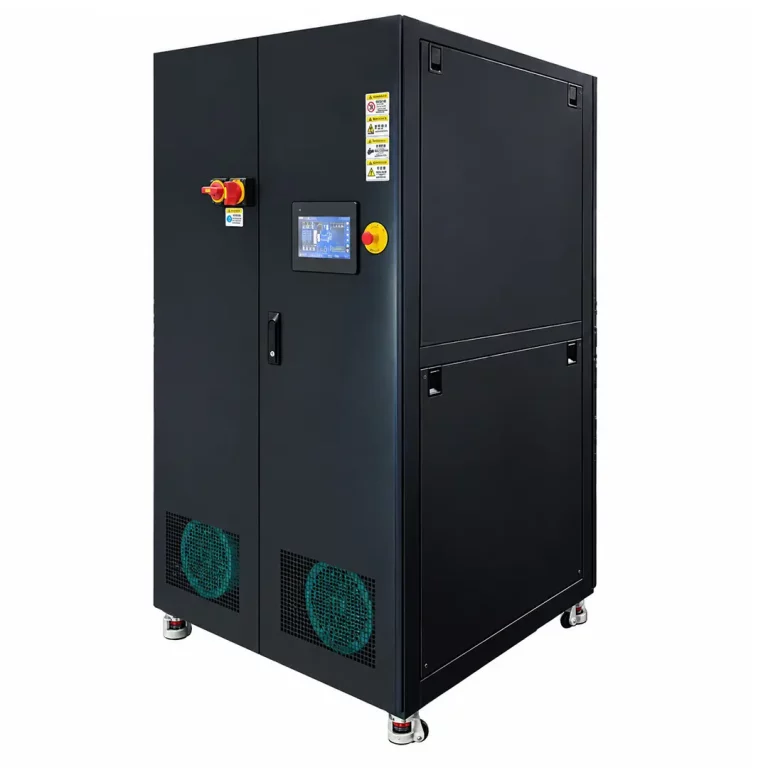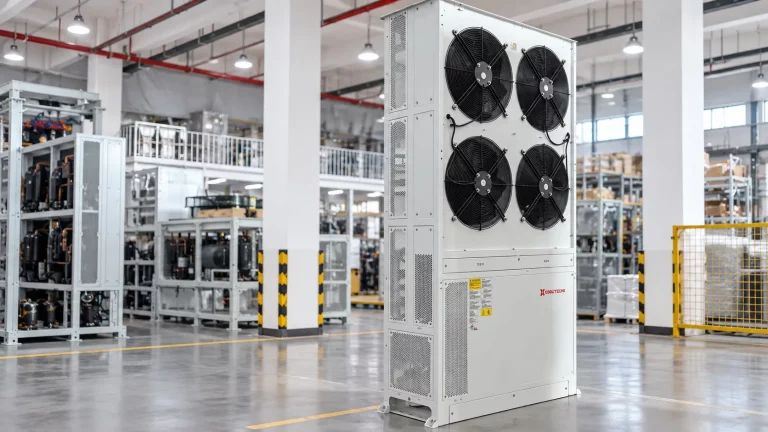

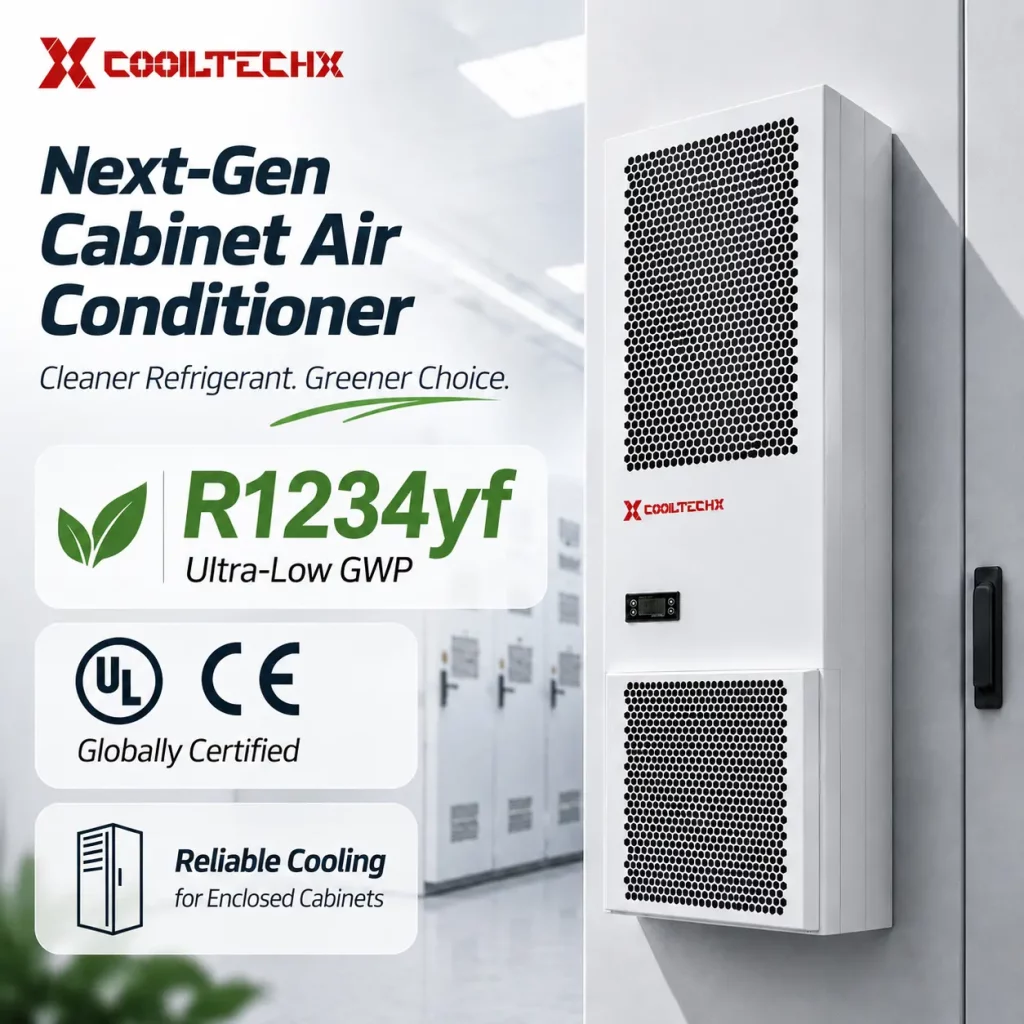
The EU’s revised F-Gas Regulation is clear: starting in 2030, stationary refrigeration equipment with a GWP above 150 will be banned from the EU market. Cabinet air conditioners — the core cooling component for telecom cabinets, outdoor enclosures, energy storage racks, and edge data centers — sit right at the center of this refrigerant transition. cooltechx’s latest generation of cabinet air conditioners now offers an R1234yf refrigerant option, dual-certified to UL and CE, giving exporters and system integrators a clear path to long-term compliance.
1. How Strict Is the New EU Regulation, Really? Three Dates to Know
In February 2024, the EU published its recast F-Gas Regulation (EU) 2024/573 — the most ambitious update since the original 2006 regulation and the 2015 HFC phase-down amendment. The end goal: a near-total phase-out of fluorinated greenhouse gases (F-gases) by 2050. For manufacturers, integrators, and buyers of cabinet air conditioners, three dates matter most:
-
From 2025: HFC quotas drop sharply to roughly 24.3% of the 2015 baseline, tightening supply and pushing up costs for traditional high-GWP refrigerants.
-
From 2027: Quotas shrink further to about 12.3% of baseline — a steeper cut than under the previous regulation.
-
From 2030: The regulation bans placing stationary refrigeration equipment — which includes cabinet air conditioners and precision cooling units — with a refrigerant GWP above 150 on the EU market. That effectively rules out mainstream refrigerants like R410A (GWP ~2088) and R134a (GWP ~1430).
This is a central pillar of the European Green Deal, and it applies to any manufacturer, importer, or distributor placing F-gases or F-gas-containing equipment on the EU market. Non-compliant products risk being held at customs, denied CE marking, or forced into costly retrofits. In practice, this means the earlier a manufacturer moves to a low-GWP refrigerant, the smoother its tendering, certification, and customs clearance process in the EU will be.
2. What Is R1234yf, and Why Is It a “Future-Proof” Refrigerant?
R1234yf (2,3,3,3-tetrafluoropropene, HFO-1234yf) belongs to the fourth generation of synthetic refrigerants — hydrofluoroolefins (HFOs). Originally developed by Honeywell and Chemours (formerly DuPont) as a replacement for R134a in automotive air conditioning, it has been in mass production for over a decade, giving it a relatively mature global supply chain and service network.
Its key advantages:
-
Ultra-low GWP: Under IPCC AR5 methodology, R1234yf has a GWP below 1 — more than 99% lower than R134a’s 1430, and comfortably under the EU’s 2030 “GWP150” threshold.
-
Zero ODP: No ozone-depleting potential, in line with the Montreal Protocol and the Kigali Amendment.
-
Performance close to R134a: Similar thermodynamic properties mean cooling capacity and efficiency are comparable, so system architecture typically doesn’t require major redesign.
-
A2L safety classification: Under ASHRAE 34 / ISO 817, R1234yf is rated “mildly flammable, low toxicity” — a meaningfully lower risk profile than A3-class natural refrigerants like propane (R290), though enclosure design still needs to account for leak detection and ventilation.
Cabinet AC Refrigerant Comparison
|
Refrigerant
|
GWP (approx.)
|
ODP
|
Safety Class
|
Notes
|
|
R410A
|
2088
|
0
|
A1 non-flammable
|
Mature and low-cost, but faces export restrictions to the EU after 2030
|
|
R134a
|
1430
|
0
|
A1 non-flammable
|
Widely used, but high GWP creates long-term compliance risk
|
|
R32
|
675
|
0
|
A2L mildly flammable
|
Lower GWP, but still well above the EU’s 150 limit
|
|
R454B
|
466
|
0
|
A2L mildly flammable
|
R32/R1234yf blend, drop-in replacement for R410A
|
|
R1234yf
|
<1
|
0
|
A2L mildly flammable
|
Best-in-class GWP, aligned with long-term EU requirements
|
Among refrigerants currently available at commercial scale, R1234yf sits at the very bottom of the GWP scale — making it one of the most direct routes to clearing the EU’s 150-GWP bar for stationary equipment.
3. Cooltechx Cabinet Air Conditioners: R1234yf Option + Dual UL/CE Certification
Alongside its existing R410A and R513A product lines, cooltechx now offers an R1234yf refrigerant option across its cabinet air conditioner range — with both UL and CE certification in place:
-
CE certification: The mandatory conformity mark for the EU/EEA market, covering the Low Voltage Directive (LVD), EMC Directive, Machinery Directive (MD), and RoHS, along with refrigeration-specific standards such as EN 378 (Refrigerating systems and heat pumps — Safety and environmental requirements). It’s the baseline requirement to legally place cooling equipment on the EU market.
-
UL certification: The leading third-party safety certification in North America, covering electrical safety, fire performance, and component reliability — an important credential for winning trust with North American EPCs and system integrators.
For companies shipping to both Europe and North America, having a single product line dual-certified means not having to develop region-specific SKUs, which cuts certification lead time and simplifies vendor selection. Because R1234yf carries an A2L mild-flammability rating, cooltechx has also reinforced enclosure sealing, leak detection, and airflow design to keep the environmental benefits without compromising on safety.
4. Where R1234yf Cabinet Air Conditioners Make Sense
Refrigerant choice matters more in some applications than others. R1234yf-based cabinet cooling is particularly well suited to:
-
Telecom base stations and 5G outdoor cabinets: Long service life with unattended operation, where refrigerant choice locks in a decade or more of compliance exposure.
-
Battery energy storage system (BESS) enclosures: High demands on temperature stability, and an application area increasingly under environmental regulatory scrutiny.
-
UPS and power distribution cabinets: Often deployed outdoors or in semi-outdoor settings; EU-bound tenders increasingly specify CE certification and low-GWP refrigerants explicitly.
-
Edge data centers and micro data modules: Smaller, distributed deployments with shorter procurement cycles, where locking in a compliant refrigerant upfront avoids retrofits later.
-
Industrial electrical, PLC, and control cabinets: High-end manufacturing environments where IP rating and environmental compliance both matter.
5. How to Choose the Right Refrigerant for Your Cabinet AC Project
There’s no single “correct” refrigerant — the right choice depends on budget, project lifespan, and target markets:
-
Domestic or non-EU markets, cost-sensitive projects: R410A remains mature, widely stocked, and inexpensive to service.
-
Balancing efficiency and environmental impact on a moderate budget: R32 is a reasonable transitional option, though its GWP of 675 still sits well above the EU’s 2030 threshold.
-
EU exports, international tenders, or long asset lifecycles: R1234yf (or R454B as an interim step) is the safer long-term bet — especially for fixed installations expected to run for 10+ years, where switching early avoids costly rework down the line.
Worth noting: R1234yf currently costs more than R410A or R134a due to raw material and production costs — an “environmental premium” buyers should weigh against export destination, project lifespan, and total cost of ownership.
6. The Takeaway: Plan Now, Stay Ahead of the Compliance Curve
The EU’s F-Gas phase-down isn’t a single cutoff — it’s a multi-stage tightening that runs through 2050. For cabinet AC manufacturers, system integrators, and end users alike, waiting until 2030 to react means scrambling under pressure. Evaluating low-GWP refrigerant options now is the more strategic move. cooltechx’s new R1234yf cabinet air conditioner option, backed by dual UL and CE certification, gives export-focused projects a longer compliance runway and a simpler path to multi-region approval.
If you’re specifying cabinet air conditioners for a project bound for the EU or North America, reach out to the cooltechx technical team for datasheets, refrigerant comparison guidance, and a custom quote.
Frequently Asked Questions
Is an R1234yf cabinet air conditioner safe?
R1234yf carries an A2L safety rating — “mildly flammable, low toxicity” — a meaningfully lower flammability risk than A3-class natural refrigerants like propane (R290). Paired with proper enclosure sealing, leak detection, and installation practices, it’s suitable for use in stationary equipment like cabinet air conditioners.
When does the new EU F-Gas Regulation take effect?
The recast F-Gas Regulation (EU) 2024/573 entered into force in March 2024. HFC quotas tighten in stages starting 2025, and from 2030 the EU will ban placing stationary refrigeration equipment with a GWP above 150 on the market, working toward a full F-gas phase-out by 2050.
Can CE certification substitute for UL certification, or vice versa?
No. CE marking is the legal requirement for placing products on the EU/EEA market, while UL certification is the most widely recognized third-party safety certification in North America. They cover different regulatory frameworks and regions — companies exporting to both typically need both.
Can R1234yf be used as a direct drop-in replacement for R134a in existing cabinet AC units?
R1234yf has thermodynamic properties similar to R134a, but its A2L safety classification (versus R134a’s A1) means seals, piping connections, and leak-detection components need to be redesigned and re-certified accordingly. It’s not a simple “top-off and swap” — choose a cabinet air conditioner engineered from the factory for R1234yf.
Does an R1234yf cabinet air conditioner cost significantly more?
The refrigerant itself costs more than R410A or R134a today, so unit pricing carries a modest environmental premium. For EU-bound projects with long asset lifespans, though, locking in compliance early typically costs less than the retrofits, re-certifications, or shipment holds that come with switching refrigerants after the fact.