
When evaluating a liquid cooling unit for a Battery Energy Storage System (BESS), cooling capacity is usually the first metric engineers, EPC contractors, and system integrators compare.
A product might be labeled as a 3 kW, 10 kW, 30 kW, or 60 kW unit. At first glance, comparing these numbers appears straightforward. However, cooling capacity is not a static or isolated value.
A specification like “10 kW cooling capacity” is incomplete—and potentially misleading—unless it includes the exact operating conditions under which that output was measured.
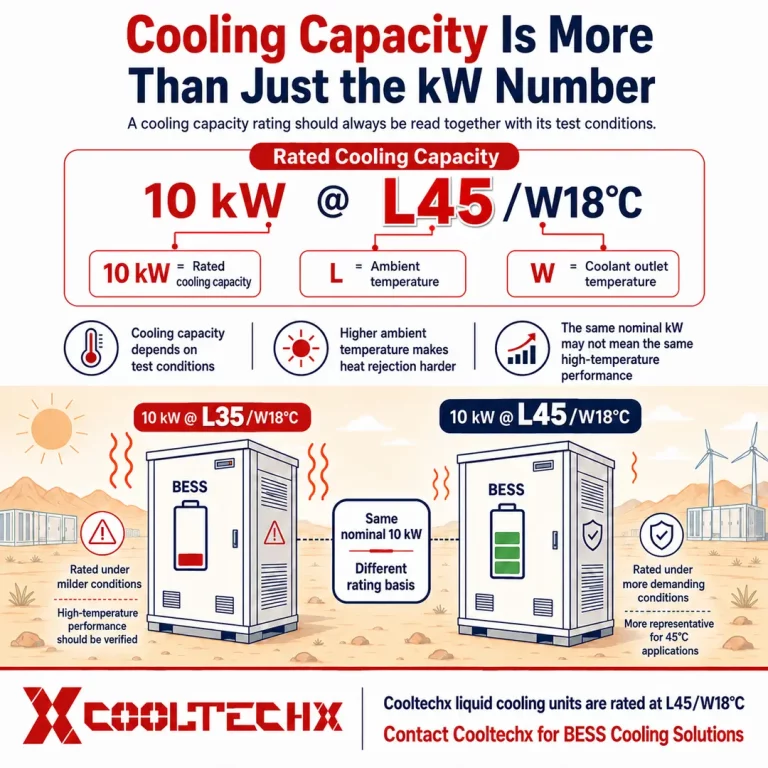
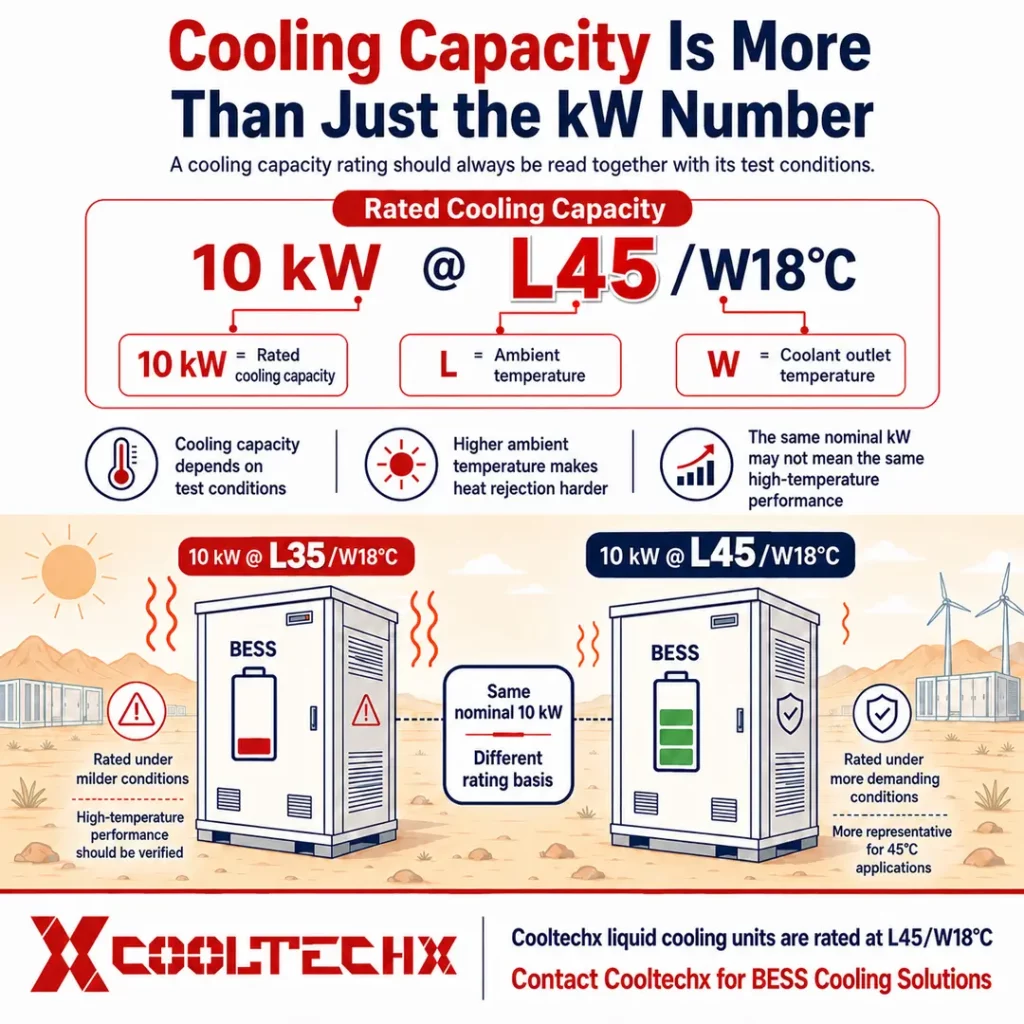
📌 Key Takeaway: A rated expression such as 10 kW @ L45/W18°C tells a complete story. It identifies not only nominal cooling output, but also the surrounding air temperature and coolant supply temperature used during lab testing.
What Does the L45/W18°C Rating Actually Mean?
The letters L and W originate from standard German HVAC/refrigeration terminology:
-
L = Luft (Air)
-
W = Wasser (Water / Liquid Coolant)
In energy storage technical documentation, an operating condition such as L45/W18°C defines the two critical boundaries of the cooling loop:
| Parameter | Notation | Meaning | BESS Context |
| Air-Side | L45 | Ambient Air Temp: 45°C | The outdoor air temperature surrounding the BESS enclosure/condenser. |
| Water-Side | W18 | Coolant Outlet Temp: 18°C | The temperature of the coolant leaving the chiller toward the battery packs. |
Therefore, a specification of 10 kW @ L45/W18°C means the unit delivers 10 kW of active cooling capacity even when operating in a harsh 45°C environment while maintaining an 18°C fluid supply.
Why Ambient Temperature Directly Impacts BESS Chiller Performance
Most modern BESS liquid thermal management systems rely on a vapor-compression refrigeration circuit involving four basic stages:
-
Evaporator: Absorbs heat from the circulating coolant loop.
-
Compressor: Raises refrigerant pressure and temperature.
-
Condenser: Rejects absorbed heat into the ambient air.
-
Expansion Device: Lowers refrigerant pressure before repeating the cycle.
The condenser is the component most vulnerable to high ambient temperatures.
When outdoor air temperature rises from 35°C to 45°C, the temperature difference between the condenser coil and the ambient air shrinks. Dissipating heat becomes significantly harder, causing domino-effect thermodynamic challenges:
-
⚠️ Higher Condensing Pressure: Forces the compressor to work harder.
-
⚠️ Increased Power Consumption (kW): Lowers overall Coefficient of Performance (COP).
-
⚠️ Thermal Derating: Available cooling capacity drops if the system reaches its operating envelope limits.
Because compressor design, refrigerant selection, fan control, and coil surface area vary across vendors, you cannot apply a universal “rule of thumb” derating percentage to all products. Capacity must be evaluated under actual project climate conditions.
Head-to-Head: L35/W18°C vs. L45/W18°C
Consider two liquid cooling units, both marketed with a headline rating of 10 kW:
-
Unit A: Rated 10 kW @ L35/W18°C (Tested at 35°C ambient)
-
Unit B: Rated 10 kW @ L45/W18°C (Tested at 45°C ambient)
While both display “10 kW” on their marketing flyers, Unit B delivers far superior thermal performance in hot environments.
Will Unit A still output 10 kW at 45°C ambient?
Not automatically. When ambient air spikes to 45°C, Unit A’s capacity will likely suffer a derating penalty—potentially dropping to 8 kW or lower depending on its refrigeration design.
Before choosing an L35-rated unit for a hot-climate installation, always request the following technical data from the supplier:
-
📊 Ambient Performance Curves (Capacity vs. Ambient Temperature)
-
⚡ Input Power & COP at L45/W18°C
-
📉 Derating Thresholds & Alarm Setpoints
-
🧪 Third-Party Lab Test Reports
Why L45/W18°C is the Gold Standard for Outdoor BESS Projects
Outdoor BESS installations face severe operational conditions, including direct solar radiation, thermal radiation from surrounding concrete pads, dust accumulation, and heat from auxiliary electronics.
Target markets like the Middle East, Australia, Southeast Asia, Southern Europe, and the U.S. Sunbelt regularly experience peak summer temperatures exceeding 40°C.
For utility-scale, commercial & industrial (C&I), solar-plus-storage, and EV ultra-fast charging stations in these regions, designing around an L45/W18°C benchmark prevents unexpected thermal throttling, battery over-temperature shutdowns, and accelerated cell degradation during peak load hours.
What About the Coolant Side? (Why W18 Matters)
The water-side rating is equally critical. In modern BESS liquid loops, the working fluid is typically a water-glycol mixture chosen for corrosion protection and freeze prevention.
The coolant absorbs heat from battery cold plates and returns to the liquid cooling unit’s evaporator. W18 specifies that the fluid leaves the cooler at 18°C.
Adjusting target coolant temperature impacts the system’s evaporating pressure:
-
Lowering coolant target (e.g., to W15): Increases battery cooling performance, but lowers evaporating pressure, increasing compressor load and condensation risk.
-
Raising coolant target (e.g., to W20): Increases COP/efficiency, but reduces thermal driving force at the cold plate level.
Comparing a W15-rated unit against a W18-rated unit is comparing apples to oranges. Always align the fluid supply temperature with your battery pack’s thermal management requirements.
5 Checklist Questions for Evaluating BESS Liquid Coolers
When reviewing technical bids from HVAC and thermal management vendors, ask these five critical questions:
1. Operating Point: Was capacity measured at L35, L40, or L45?
2. Fluid Metric: Does 'W' explicitly denote Coolant Outlet Temp?
3. Load Type: Is capacity stated as Net, Sensible, or Gross Capacity?
4. System Input Power: What is total power draw (compressor+fans+pump)?
5. Full Envelope: Is a complete Performance Curve Matrix available?
Common Mistakes When Comparing Cooling Capacity
-
Comparing Raw kW Numbers Only: Ignoring ambient and fluid testing conditions.
-
Confusing Max Operating Temp with Rated Capacity Temp: A unit rated to survive up to 55°C ambient may deliver less than 60% of nominal cooling at that peak.
-
Ignoring Auxiliary Energy Draw: A unit that maintains capacity at high ambient temps by running fans and pumps at extreme power levels will drain your BESS overall round-trip efficiency (RTE).
Cooltechx BESS Liquid Cooling: Engineered and Rated at L45/W18°C
At Cooltechx, we design our energy storage thermal management systems to perform under the toughest real-world environments.
To ensure complete transparency and engineering accuracy, the rated cooling capacity across our entire BESS liquid cooling portfolio is natively benchmarked at L45/W18°C.
| COOLTECHX ADVANCED BESS THERMAL FEATURES |
| ✓ Full-Inverter Variable-Speed Compressors & EC Fans |
| ✓ Integrated Cooling, PTC Heating & Coolant Circulation Loops |
| ✓ Dynamic Precision Coolant Temperature Control (±0.5°C) |
| ✓ Smart RS485 / Modbus RTU / CAN Bus Integration |
| ✓ Outdoor IP54/IP55 Ruggedized Enclosure Designs |
| ✓ Eco-Friendly, Low-GWP Refrigerant Options |
Conclusion
Cooling capacity is far more than a simple kilowatt figure on a technical specification sheet. It is a dynamic variable governed by physics and environmental boundaries.
A 10 kW @ L35/W18°C cooler is not equivalent to a 10 kW @ L45/W18°C cooler. For outdoor energy storage systems deployed in hot climates, insisting on L45/W18°C rated capacity provides the thermal headroom necessary to safeguard battery health, extend lifecycle performance, and prevent unexpected shutdowns.
Frequently Asked Questions (FAQ)
Q1: What does L45/W18°C mean for a BESS liquid cooling unit?
L45 indicates an outdoor ambient air temperature of 45°C, while W18 indicates a coolant supply (outlet) temperature of 18°C. Together, they establish the exact operating point at which the unit’s rated cooling capacity is verified.
Q2: Why are the letters L and W used instead of A and W?
The terminology originates from standardized German HVAC/refrigeration conventions: L stands for Luft (air) and W stands for Wasser (water/coolant).
Q3: Is a 10 kW unit rated at L35 equal to a 10 kW unit rated at L45?
No. The unit rated at L45/W18°C is certified to deliver 10 kW under significantly more demanding ambient heat rejection conditions. The L35 unit will likely suffer capacity derating when exposed to 45°C ambient air.
Q4: Does maximum operating temperature equal rated cooling temperature?
No. Maximum operating temperature (e.g., 55°C) is the thermal limit where the system can run without safety shutdowns. Rated cooling temperature is the specific test point where published cooling capacity is measured.
Need High-Performance BESS Thermal Management?
Explore our full range of L45/W18°C certified liquid cooling systems, or speak with a Cooltechx thermal engineer today to optimize cooling performance for your energy storage project.