

Globally, Containerized Energy Storage Systems (ESS) are entering a new phase defined by “large-scale deployment + harsh operating environments.” Challenges such as desert heat, island salt spray, high-altitude thin air, cold starts, and frequent charge/discharge cycles are amplifying one critical variable: Temperature.
For energy storage, thermal management is not just about “keeping equipment from overheating.” It determines:
- Battery Cycle Life: Whether the degradation curve is controllable.
- System Availability: Whether uptime is stable.
- Safety Boundaries: Including the suppression capability of the thermal runaway chain.
- Total Cost of Ownership (TCO): Whether lifecycle costs are predictable.

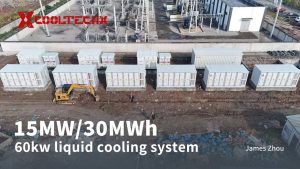
For engineers and integrators seeking a reliable 60kW ESS Liquid Cooling System, selecting the right unit is critical. This article provides a deep dive into Cooltechx‘s 60kW Liquid Cooling System (PACK + PCS Dual Circuit), analyzing it from an engineering delivery perspective. We cover why dual-circuit thermal management is essential, how to design control logic, and how to avoid common O&M pitfalls.
1. Why Containerized ESS Needs “System-Level Thermal Management”
In a typical containerized ESS architecture, heat sources include not just the battery racks (PACK), but also the Power Conversion System (PCS), Power Distribution Unit (PDU), cable losses, and control cabinets.
If thermal management is treated simply as “cooling the battery,” common issues will inevitably surface later:
- PACK temperature is stable, but PCS temperature drifts: Leading to derating, efficiency loss, or frequent high-temperature protection trips during summer.
- Battery module average temperature is fine, but temperature difference (ΔT) increases: Amplifying cell inconsistency, accelerating capacity fade, and complicating SOC/SOH estimation.
- Condensation/Local supercooling during mode switching: Invisible in the short term, but eating away at reliability over the long term.
Therefore, a thermal control system for global delivery, specifically a robust ESS Liquid Cooling System, must be “System-Level”: capable of handling both the heat flux from high energy density and the environmental disturbances from the deployment scene.
2. PACK + PCS Dual Circuit: Decoupling Risks, Not Just Stacking Specs
Many projects initially overlook PCS thermal management, leaving it to container ventilation or localized air cooling. This might work in low-power, mild environments, but once in high-temperature, heavy-load, or high-altitude scenarios, the PCS becomes the bottleneck.
The value of a dual-circuit ESS Liquid Cooling System (PACK + PCS) lies in:
- Decoupling Demands: The “optimal temperature range” and “thermal dynamics” of PACK and PCS are completely different.
- Clearer Control Targets: PACK prioritizes stability and uniformity; PCS prioritizes power device safety and efficiency windows.
- Reducing Interference: Avoiding scenarios where “aggressive cooling for PCS leads to overcooling/condensation risks in the PACK.”
From an engineering perspective, dual circuits don’t add complexity; they define clearer system boundaries, making commissioning more controllable.
3. Control Logic of a High-Performance ESS Liquid Cooling System
A superior ESS Liquid Cooling System must embed operational strategies into its design, rather than relying on on-site parameter tuning.
Taking the Cooltechx ESS Liquid Cooling System as an example, standard system-level modes include:
- Automatic Mode: Automatically switches between cooling, heating, equalization, and standby based on setpoints, ambient temp, inlet/outlet fluid temp, and load status.
- Cooling Mode: Prioritizes “stability” over “maximum cooling speed.”
- Heating Mode: Critical for cold starts in freezing regions, ensuring cells remain within the allowable charge/discharge window.
- Equal Temperature / Self-Circulation Mode: Reduces temperature differences (ΔT) through circulation without active cooling/heating, improving consistency with minimal energy consumption.
- Standby Mode: Reduces power consumption while maintaining safety boundaries, ready for the next command.
These modes are not just “functions”; they are engineering experience solidified into a replicable control framework.
4. Intelligent Replenishment & Low-Level Alerts: Solving O&M Uncertainty
The reality of overseas projects often includes:
- Varying skill levels of O&M personnel.
- Unstable on-site response times.
- Long supply chains for spare parts and consumables.
Therefore, the ESS Liquid Cooling System must be sensitive to “Water Loop Risks.” Features include:
- Continuous Pressure & Level Monitoring: Identifying trends of fluid loss early.
- Intelligent Replenishment: Minimizing the risk of fluid shortage within a controllable range via an integrated expansion tank.
- Low-Level Alerts & Linkage Protection: Transforming faults from “sudden shutdowns” to “predictable maintenance.”
While less flashy than “cooling capacity,” these capabilities often determine whether a project can run stably for a full 12 months.
5. Remote Monitoring & Protocols: From “Connectable” to “Deliverable”
For global ESS projects, the ESS Liquid Cooling System must integrate seamlessly into the EMS/BMS/PCS control architecture. This requires:
- Protocol Friendliness: Supporting standard industrial protocols like Modbus / CAN for rapid integration.
- Information Completeness: Beyond basic on/off and temp readings, it must report key component status, fault levels, operating modes, setpoints, and protection triggers.
True delivery isn’t just about communication; it’s about:
- Rapid Fault Localization during commissioning.
- Trend Analysis during remote O&M.
- Root Cause Tracing when faults occur (not just seeing an error code).
6. Reliability for Global Conditions: Treating Extremes as Normal
Global deployment means high heat, humidity, salt spray, sandstorms, extreme cold, and high altitude can all appear in the same product portfolio.
Reliable engineering practices for an ESS Liquid Cooling System include:
- Making Wide Temperature Range (-30°C to 55°C) a baseline capability, not an option.
- Ensuring IP Ratings (IPX5/IP67) for core components as a prerequisite for stable operation.
- Incorporating Design Life and key component cycle life into the metric system.
- Offering configurable Anti-Corrosion Levels (C3-C5) based on regional needs.
This ensures consistent delivery quality for the “same platform” across different countries and environments.

7. Typical Applications (Global Market)
The Cooltechx 60kW ESS Liquid Cooling System is typically matched with:
- Grid-side and Source-side Large-Scale Containerized ESS.
- C&I Energy Storage and Campus Microgrids.
- Renewable Energy Integration Storage.
- Energy Infrastructure in Extreme Environments (High Temp/Humidity/Altitude).
FAQ
Q1: Why must ESS thermal management focus on both PACK and PCS?
PACK targets cell life and consistency, while PCS targets power device safety and efficiency. Their thermal dynamics differ, so splitting them into dual circuits clarifies risk boundaries.
Q2: What does the “Equal Temperature / Self-Circulation Mode” of an ESS Liquid Cooling System actually solve?
It mainly addresses the Temperature Difference (ΔT) issue. Even if the average temperature is fine, a high ΔT between modules accelerates degradation and complicates control. This mode suppresses ΔT with low energy consumption.
Q3: Why are intelligent replenishment and low-level alerts critical for overseas projects?
Because on-site maintenance response times are unpredictable. Transforming fluid shortage risks from “sudden shutdowns” to “predictable maintenance” significantly improves availability and lowers O&M costs.
Q4: What key data should the thermal system provide to EMS/BMS/PCS?
Beyond temperature, it should include operating modes, setpoints, key component status, fault levels, and protection reasons to facilitate remote O&M, trend analysis, and fault review.
Conclusion: Thermal Management is the “Chassis” of ESS
As energy storage enters the stage of large-scale delivery, the value of the ESS Liquid Cooling System becomes increasingly like a car’s “chassis”—unnoticeable in daily use, but decisive for long-term stability in the real world.
Cooltechx‘s global liquid cooling solution aims to lock uncertainty inside the system: through PACK+PCS dual-circuit management, executable control strategies, and remote-friendly design, ensuring consistent operation quality across diverse environments and loads.
Need to match your project’s specific conditions (High Temp, Salt Spray, High Altitude, Cold Start) or system interfaces (EMS/BMS/PCS)? We can provide specific control strategies and integration advice based on your system architecture.